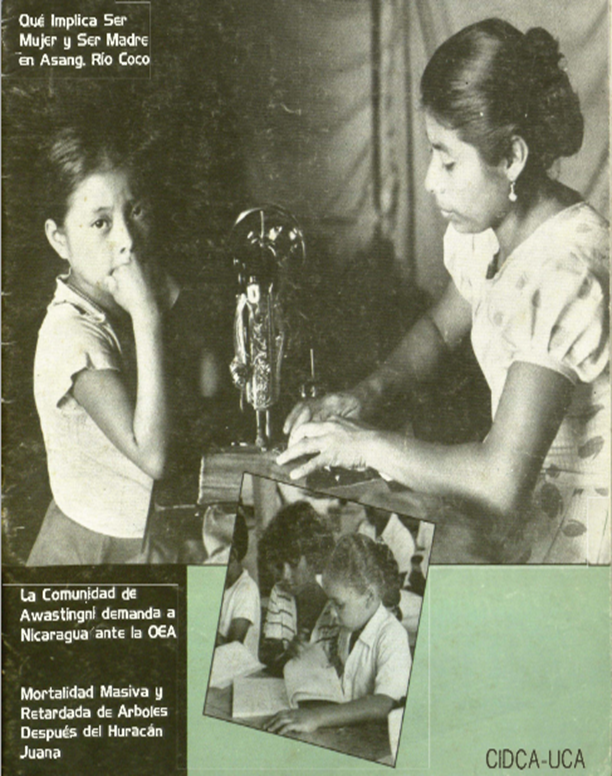
Qué implica ser mujer y ser madre en Asang, rio Coco
Palabras clave:
Identidad cultural, Madre, Miskito, Mujer y desarrollo, Papel de la familia, Papel socialResumen
El objetivo de esta investigación es examinar la importancia social de la maternidad entre los miskitos de Asang. El principal argumento es que la mujer como madre es un actor social y que las estrategias que ella emplea cada día deben ser tomadas en cuenta en las consideraciones teóricas. El trabajo de la mujer permite la supervivencia de la tradición y el mantenimiento de la identidad étnica. Este artículo está basado en datos obtenidos a través de la observación directa, entrevistas y el uso de un cuestionario acerca de la estructura de la familia.
Descargas
336
Citas
Collins, P. (1994). Shifting the center: Race, class and feminist theorizing about motherhood. In D. Bassin, M. Honey, & M. Kaplan (Eds.), Representations of motherhood (pp. 56-74). Yale University Press.
García, C. (1996). The making of the Miskitu people of Nicaragua: The social construction of ethnic identity (No. 41). Acta Universitatis Upsaliensis.
Harris, O. (1981). Households as natural units. In K. Young, C. Wolkowitz, & R. McCullagh (Eds.), Of marriage and the market (pp. 49-68). CSE Books.
Helms, M. (1971). Asang: Adaptaciones al contrato cultural en una comunidad miskita. Instituto Indigenista Interamericano.
Rosaldo, M. Z. (1974). Women, culture and society: A theoretical overview. In M. Z. Rosaldo & L. Lamphere (Eds.), Women, culture and society (pp. 17-42). Stanford University Press.
Stack, C. (1974). All our kin: Strategies for survival in a Black community. Harper & Row.
Strathern, M. (1980). No nature, no culture: The Hagen case. In C. MacCormack & M. Strathern (Eds.), Nature, culture and gender (pp. 174-222). Cambridge University Press.
Descargas
Publicado
Cómo citar
Número
Sección
Licencia
Derechos de autor 2024 Bluefields Indian and Caribbean University

Esta obra está bajo una licencia internacional Creative Commons Atribución-NoComercial-CompartirIgual 4.0.


