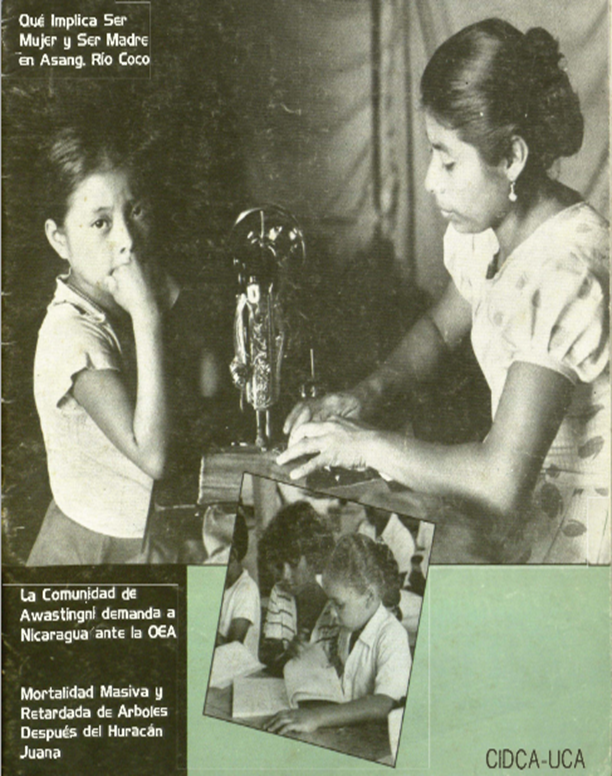
What it means to be a woman and a mother in Asang, Cocos river
Keywords:
Cultural identity, Miskito, Mother, Role of the family, Social role, Women and developmentAbstract
The subject of this paper is to examine the social importance of motherhood among the miskitu people of Asang. The main argurnent is that women as mothers are social actors, and the strategies they employ in everyday life must be taken into theoretical consideration. The work of a mother allows the survival of traditions as well as the maintenance of ethnic identity. This article is based on data obtained through direct observation, interviews and the use of a questionnaire on the structure e of the household.
Downloads
336
References
Collins, P. (1994). Shifting the center: Race, class and feminist theorizing about motherhood. In D. Bassin, M. Honey, & M. Kaplan (Eds.), Representations of motherhood (pp. 56-74). Yale University Press.
García, C. (1996). The making of the Miskitu people of Nicaragua: The social construction of ethnic identity (No. 41). Acta Universitatis Upsaliensis.
Harris, O. (1981). Households as natural units. In K. Young, C. Wolkowitz, & R. McCullagh (Eds.), Of marriage and the market (pp. 49-68). CSE Books.
Helms, M. (1971). Asang: Adaptaciones al contrato cultural en una comunidad miskita. Instituto Indigenista Interamericano.
Rosaldo, M. Z. (1974). Women, culture and society: A theoretical overview. In M. Z. Rosaldo & L. Lamphere (Eds.), Women, culture and society (pp. 17-42). Stanford University Press.
Stack, C. (1974). All our kin: Strategies for survival in a Black community. Harper & Row.
Strathern, M. (1980). No nature, no culture: The Hagen case. In C. MacCormack & M. Strathern (Eds.), Nature, culture and gender (pp. 174-222). Cambridge University Press.
Downloads
Published
How to Cite
Issue
Section
License
Copyright (c) 2024 Bluefields Indian and Caribbean University

This work is licensed under a Creative Commons Attribution-NonCommercial-ShareAlike 4.0 International License.


