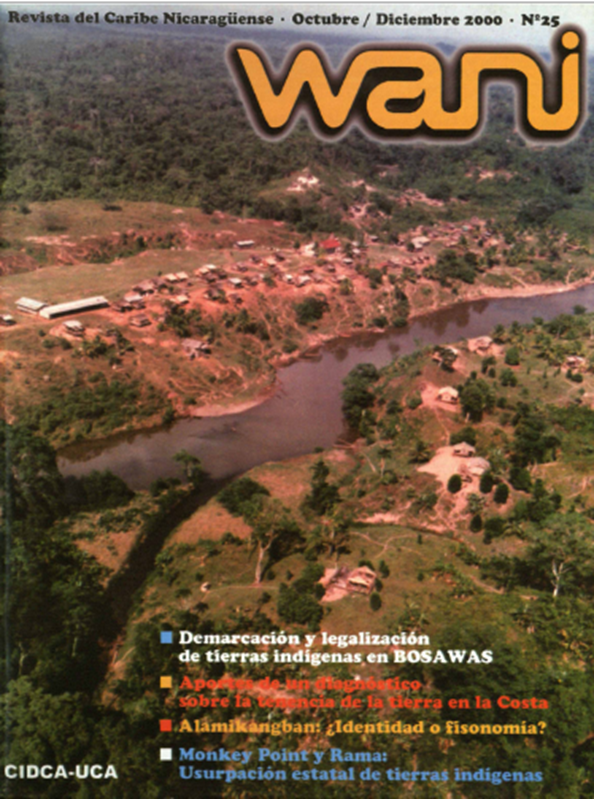
Alamikangban: identity or physiognomy?
Keywords:
Communal land, Cultural identity, Ethnic issues, History, Land legislation, Land tenure of indigenous peoples, MulticulturalismAbstract
This work is an attempt to reflect on the conditions that make possible that which traditionally has been called the indigenous. ethnic. or communal identity Based on the case of the indigenous community of Alamikangban. The author argues and illustrates the use and the implications of the complex dynamic frame of reference. of defining. from a position of power, the negatively highlighting subordinate identities. And the reply/authorship from the subordinate actors affirming their existence and membership.
Downloads
442
References
Bhabha, H. K. (1994). The Location of Culture. London: Routledge.
Benjamin, W. (1985). Illuminations (H. Zohn, Trans.). New York: Schocken Books.
Beverley, J., & Oviedo, M. (1993). The Postmodernist Debate in Latin America. Boundary 2, 20(3), Fall. Durham: Duke University Press.
Bradford Burns, E. (1991). Patriarch and Folk: The Emergence of Nicaragua, 1798–1858. Cambridge: Harvard University Press.
Briggs, C. (1992). Linguistic ideologies and the naturalization of power in Warao. Pragmatics, 2(3), 387–404.
Derrida, J. (1976). Of Grammatology (G. C. Spivak, Trans.). Baltimore: Johns Hopkins University Press.
Eagleton, T. (1991). Ideology: An Introduction. London: Verso.
Forgacs, D. (Ed.). (1988). The Antonio Gramsci Reader. New York: Schocken Books.
Friedrich, P. (1989). Language, ideology, and political economy. American Anthropologist, 91(2), 295–312.
Friedrich, P. (1991). Polytropy. In J. W. Fernandez (Ed.), Beyond Metaphor (pp. 17–55). Stanford: Stanford University Press.
García Canclini, N. (1990). Culturas híbridas: Estrategias para entrar y salir de la modernidad. México, D.F.: Grijalbo.
Goffman, E. (1959). The Presentation of Self in Everyday Life. New York: Anchor Books.
Gould, J. (1997). El mito de “La Nicaragua mestiza” y la resistencia indígena, 1880–1980. San José, C.R.: Editorial de la Universidad de Costa Rica.
Hale, C. R. (1991). Wan Tasbaya Dukiara: Nociones contenciosas de los derechos sobre la tierra en la historia miskita. Wani, 12, 78–102.
Hall, S. (1985). Signification, representation, ideology: Althusser and the post-structuralist debates. Critical Studies in Mass Communication, 2(2), June.
Hanks, W. F. (1987). Discourse genres in a theory of practice. American Ethnologist, 14(4), 668–692.
IWGIA (Ed.). (1983). National Revolution and Indigenous Identity: The Conflict Between Sandinistas and Miskito Indians on Nicaragua’s Atlantic Coast (K. Ohland & R. Schneider, Eds.). Copenhagen: IWGIA.
Laclau, E., & Mouffe, C. (1990). Hegemony and Socialist Strategy: Towards a Radical Democratic Politics. London: Verso.
Merz, E. (1992). Linguistic ideology and praxis in U.S. law school classrooms. Pragmatics, 2(3), 325–334.
Ms. Hall. (1994). Mestizaje, Hybridity, and the New Politics of Cultural Difference in Post-Revolutionary Central America. Manuscript.
OPHDESCA. (1992). Caracterización del territorio del río Prinzapolka. Manuscrito (Ms.).
Oertzen, E., et al. (1992). The Nicaraguan Mosquitia in Historical Documents, 1844–1927. Berlin: Dieter Verlag.
Peralta, M. de. (1898). Costa Rica y Costa de Mosquitos. París: Imprenta General de Lahure.
Ruiz y Ruiz, F. (1925). Informe sobre la Costa Atlántica. Manuscrito.
Rizo, M. (1992). Etnicidad, legalidad y demandas de las comunidades indígenas del norte, centro y pacífico de Nicaragua. In Persistencia indígena en Nicaragua. Managua: CIDCA-UCA.
Wolfe, J. (1996). Becoming mestizo: Ethnicity, culture and nation in Nicaragua, 1850–1900. Paper presented at Tercer Congreso Centroamericano de Historia, San José, Costa Rica, 15–18 de julio de 1996.
Zubiri, X. (1972). Sobre la esencia. Madrid: Sociedad de Estudios y Publicaciones.
Anónimo. (1995). Compilación de documentos históricos sobre la Costa Atlántica. Managua, Guatemala y Centroamérica. México, D.F.: Universidad Metropolitana.
Manuscrito (s.f.). Transcripción de los títulos de tierras de las comunidades indígenas otorgados por el tratado Harrison-Altamirano. Bluefields. Manuscrito.
Downloads
Published
How to Cite
Issue
Section
License
Copyright (c) 2024 Bluefields Indian and Caribbean University

This work is licensed under a Creative Commons Attribution-NonCommercial-ShareAlike 4.0 International License.


