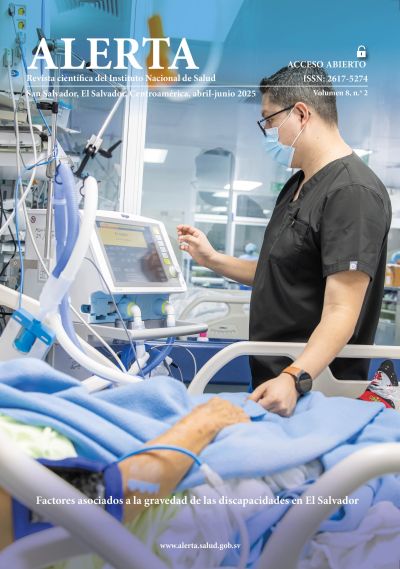
Factores asociados a la gravedad de las discapacidades en El Salvador
DOI:
https://doi.org/10.5377/alerta.v8i2.20311Palabras clave:
Estudios de la Discapacidad, Encuestas de Salud, Análisis de Datos Secundarios, Estadísticas de Secuelas y DiscapacidadResumen
Introducción. La discapacidad se acompaña de dificultades físicas, mentales, intelectuales o sensoriales. En el mundo se calcula que el 15 % de la población tiene algún tipo de discapacidad. Esta condición es un concepto dinámico que involucra la relación entre la persona, entorno físico y ambiente social. Objetivo. Determinar los factores asociados a gravedad de discapacidad en la Encuesta Nacional de Salud, El Salvador. Metodología. Estudio transversal analítico, a partir de la Encuesta Nacional de Salud 2021, incluyó a personas registradas con discapacidad en los ejes: vista, audición, caminar, cognición, autocuidado y comunicación, registrados mediante el cuestionario del Grupo Washington. Se utilizó estadística descriptiva, pruebas U de Mann Whitney; la asociación se determinó por Odds Ratio, intervalos de confianza al 95 % y valor de p < 0,05. Se construyó un modelo de regresión logística. Resultados. El 17,1 % de las personas presentaron discapacidad, el 58,4 % pertenece al sexo femenino y el 62,9 % a zona urbana. El tipo de discapacidad por indicador de gravedad con mayor frecuencia fue leve con el 63,7 %, el 37,4 % presentó dificultad funcional para ver y la prevalencia total de la condición de discapacidad en los ejes evaluados por la Encuesta Nacional de Salud fue de: 17,1 % (IC 95 %: 16,8-17,4). El factor que presentó mayor asociación fue la presencia de enfermedades crónicas con Odds Ratio de 2,1 (IC 95 %: 1,15-1,76) p < 0,05. Conclusión. La edad avanzada y la presencia de enfermedades crónicas fueron los factores asociados a la gravedad de la discapacidad.
Descargas
1036
PDF (English) 91
Descargas
Publicado
Cómo citar
Número
Sección
Licencia
Derechos de autor 2025 Cesar Mateo Gavidia Leiva, Rhina Lissette Domínguez de Quijada

Esta obra está bajo una licencia internacional Creative Commons Atribución 4.0.
Declaración de privacidad:
Los artículos de Revista Alerta están publicados bajo una licencia creative commons 4.0 CC BY: https://creativecommons.org/licenses/by/4.0/

Los autores conservan todos sus derechos sobre la obra y acuerdan permitir que los artículos sean copiados y distribuidos por cualquier medio, siempre que se mantenga su autoría y reconocimiento de la publicación, sin otras restricciones adicionales.


