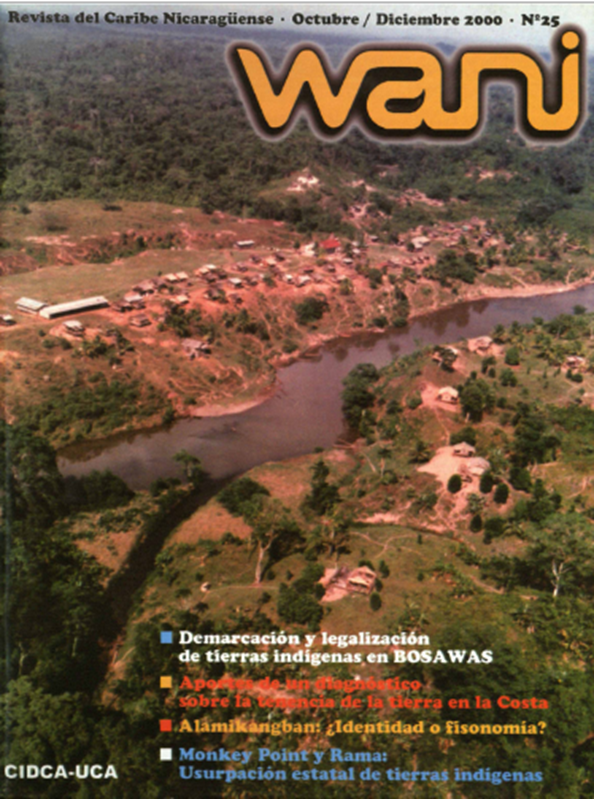
El activismo ecológico indígena en Nicaragua: demarcación y legalización de tierras indígenas en Bosawas
Palabras clave:
Legislación agraria, Pueblos indígenas, Reclamación de tierras, Reserva natural, Tierra comunal, Utilización de la tierraResumen
En este artículo se presenta el activismo ecológico de los indígenas que habitan en BOSAWAS. La Reserva Internacional de Biósfera que contiene la parte meridional de bosque subtropical húmedo intacto más grande de Centroamérica. Sus autores describen el proceso de demarcación y legalización de tierras emprendido por estos indígenas. Analizan el modelo de co-manejo y administración por territorio propuesto por ellos. sus diferentes etapas en el proceso y la metodología empleada. Finalmente esbozan el papel que deberían juzgar los principales actores involucrados en este proceso de demarcación y legalización de estas tierras indígenas.
Descargas
345
Citas
Abruzzi, William. 1982. "Ecological Theory and Ethnic Differentiation among Human Populations." Current Anthropology 23(1): 13–35.
Amnesty International. 1992. Human Rights Violations Against the Indigenous Peoples of the Americas. New York, NY: John D. Lucas Printing Company.
Arellano, Sonia, and Evelio Arambiza. n.d. "NGOs, the State and Civil Society: The Case of the Capitanía de Alto y Bajo Izozog and the Fundación Ivi-Iyambae." In Toward an Anthropology of NGOs, edited by L. Markowitz and C. Grimm. [Forthcoming].
Arentz, Frans. 1996. "Forestry and Politics in Sarawak." In Resources, Nations, and Indigenous Peoples: Case Studies from Australia, Melanesia, and the South Pacific, edited by R. Howitt, J. Connell, and P. Hirsch, 212–210. New York: Oxford Press.
Barth, Fredrik, ed. 1956. "Ecological Relationships of Ethnic Groups in Swat, North Pakistan." American Anthropologist 58: 1079–1089.
———. 1969. Ethnic Groups and Boundaries: The Social Organization of Cultural Difference. Boston: Little, Brown and Company.
Bebbington, Anthony. 1996. "Organizations and Intensifications: Campesino Federations, Rural Livelihoods and Agricultural Technology in the Andes and Amazonia." World Development 24(7): 1161–1177.
Brosius, J. Peter, Anna Lowenhaupt Tsing, and Charles Zerner. 1998. "Representing Communities: Histories and Politics of Community-Based Natural Resource Management." Society and Natural Resources 11: 157–168.
Buvollen, Hans Peter, and Haí Almquist Buvollen. 1994. "Demografía de la RAAN." Wani (Managua, Nicaragua), March: 5–19.
Chirif, Alberto, P. García, and R. C. Smith. 1991. El Indígena y su Territorio Son Uno Solo: Estrategias para la Defensa de los Pueblos y Territorios Indígenas en la Cuenca Amazónica. Lima, Peru: Oxfam America/COICA.
EPA (Environmental Protection Agency). 1984. EPA's Policy for the Implementation of Environmental Programs on Indian Reservations, November 8, 1984. Washington, DC: EPA.
Herlihy, Peter. 1992. "Wildlands Conservation in Central America During the 1980s: A Geographical Perspective." Geographic Research in Latin America: Benchmark 1990 (Yearbook, Conference of Latin Americanist Geographers) 17/18: 31–43.
Horowitz, Leah Sophie. 1998. "Integrating Indigenous Resource Management with Wildlife Conservation: A Case Study of Batang Ai National Park, Sarawak, Malaysia." Human Ecology 26(3): 371–403.
Howard, Sarah. 1996. "Autonomy and Territorial Rights of the Sumu People in Bosawas: The Case of Sikilta." Wani (Managua, Nicaragua), January/April: 3–18.
Kruse, Jack, Dave Klein, Steve Braund, Lisa Moorehead, and Bill Simeone. 1998. "Co-Management of Natural Resources: A Comparison of Two Caribou Management Systems." Human Organization 57(4): 447–458.
Lynch, Owen J., and Janis Alcorn. 1994. "Tenurial Rights and Community-Based Conservation." In Natural Connections: Perspectives in Community-Based Conservation, edited by D. Western and R. M. Wright, 373–392. Washington, DC: Island Press.
Nietschmann, Bernard. 1989. The Miskito Nation, Nicaragua and the United States: The Unknown War. New York: Random House.
———. 1993. "The Development of Autonomy in the Miskito Nation." Fourth World Bulletin 2(2), February.
———. 1997. "Protecting Indigenous Coral Reefs and Sea Territories: Miskito Coast, RAAN, Nicaragua." In Conservation Through Cultural Survival: Indigenous Peoples and Protected Areas, edited by S. Stevens, 193–224. Covelo, CA: Island Press.
Ortiz, Roxanne Dunbar. 1990. "The Future of the Miskito People in a Troubled Borderland." Nicaraguan Perspectives, Fall/Winter: 15–19.
Ostrom, Elinor. 1990. Governing the Commons: The Evolution of Institutions for Collective Action. New York: Cambridge University Press.
———. 1996. Rules, Games, and Common Property Resources. Ann Arbor: The University of Michigan Press.
———, J. Walker, and R. Gardner. 1994. "Covenants With and Without a Sword: Self-Governance Is Possible." American Political Science Review 86(2): 404–417.
Painter, Michael, and Andrew Noss. 1999. "Conservación de fauna con organizaciones comunales: experiencia con el pueblo Izoceño en Bolivia." Ponencia presentada al IV Congreso Internacional de Manejo de Fauna Silvestre en la Amazonía y Latinoamérica, Asunción, Paraguay, 4–8 de octubre de 1999.
Poole, Peter. 1989. Developing a Partnership of Indigenous Peoples, Conservationists, and Land Use Planners in Latin America. Working Papers on Environment of the World Bank Latin America and the Caribbean Technical Department.
Scherer, Christian P. 1994. "Regional Autonomy in Eastern Nicaragua (1990–1994)." In Indigenous Peoples’ Experiences with Self-Government, edited by Assies and Hoekema, 109–148.
Siemann, Dan. 1993. Overcoming Conflicts with the Endangered Species Act: Building Tribal Endangered Species Management Capacity. Report to the White Mountain Apache Tribe. Harvard Project on Native American Indian Economic Development, Project Report Series 93-3.
Stahler-Sholk, Richard. 1995. "Sandinista Economic and Social Policy: The Mixed Blessings of Hindsight." Latin American Research Review 30(2): 235–250.
Stevens, Stan, ed. 1997. Conservation Through Cultural Survival: Indigenous Peoples and Protected Areas. Covelo, CA: Island Press.
UNESCO. 1968. Proceedings of the UNESCO Intergovernmental Conference of Experts on the Scientific Basis for Rational Use and Conservation of the Biosphere, Paris, 4–13 Sept. 1968.
UICN (Unión Internacional para la Conservación de la Naturaleza). 1997. Resolutions and Recommendations of the World Conservation Congress, Montreal, Canada, 13–15 October 1996. Geneva: IUCN.
Valenzuela, M. 1993. "The Bosawas Nature Reserve and the Indigenous Communities: An Uncertain Future." Barricada Internacional 13(362): 14–16.
Varese, Stefano. 1996. "The New Environmentalist Movement of Latin American Indigenous People." In Valuing Local Knowledge: Indigenous People and Intellectual Property Rights, edited by S. Brush and D. Stabinsky, 122–142. Covelo, CA: Island Press.
Warner, Michael. 1997. "Consensus Participation: An Example for Protected Areas Planning." Public Administration and Development 17: 413–432.
West, Patrick C., and S. R. Brechin, eds. 1991. Resident Peoples and National Parks: Social Dilemmas and Strategies in International Conservation. Tucson: University of Arizona Press.
Western, David, and R. Michael Wright, eds. 1994. Natural Connections: Perspectives in Community-Based Conservation. Covelo, CA: Island Press.
Descargas
Publicado
Cómo citar
Número
Sección
Licencia
Derechos de autor 2024 Bluefields Indian and Caribbean University

Esta obra está bajo una licencia internacional Creative Commons Atribución-NoComercial-CompartirIgual 4.0.


