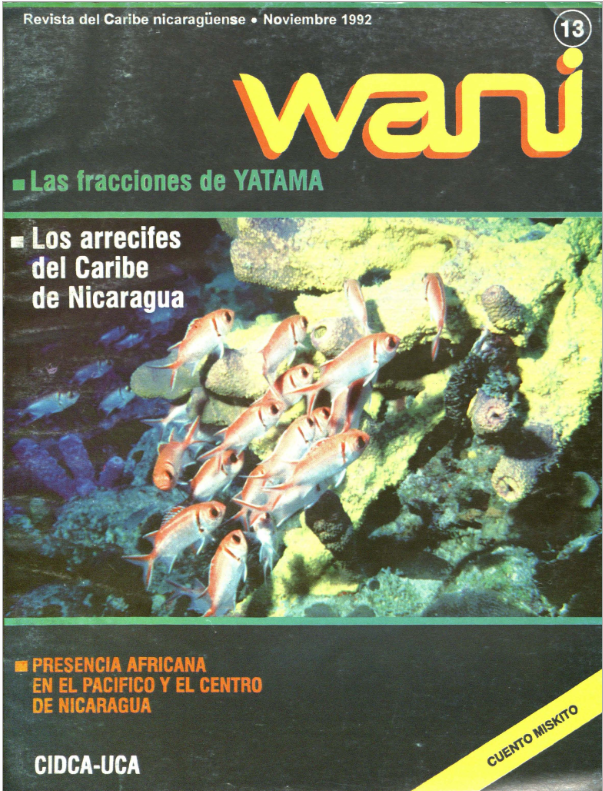
La presencia africana en el pacífico y el centro de Nicaragua
Palabras clave:
África, Asentamiento humano, Geografía histórica, Historia, MigraciónResumen
Nicaragua ha sido, desde los tiempos más remotos hasta nuestros días, un lugar de encuentro y mezcla de grupos humanos de razas y culturas diferentes, originarios de Asia, Europa y África. Tales grupos, llegados en épocas distintas, por variados caminos y en disímiles condiciones y circunstancias, han hecho contribuciones a la historia del país, sujetas a la coyuntura en que les tocó insertarse, en el proceso de la formación social del mismo. Es interés del historiador preocupado por esclarecer el pasado de la sociedad objeto de su estudio, analizar en sí y en sus relaciones con los otros grupos, cada uno de estos elementos que entran en la totalidad del proceso socio-histórico. Es en tal sentido que el estudio de la población de origen africano en Nicaragua adquiere sus dimensiones y significado. La posición geográfica de Nicaragua en el hemisferio americano ha sido propicia a la ocupación de diferentes grupos humanos. En efecto, situada en pleno corazón del istmo centroamericano, se halla bañada por dos océanos, a relativamente corta distancia uno del otro e, incluso, comunicables entre sí a través del río San Juan, el Gran Lago y el istmo de Rivas. Por otra parte, la abundancia de ríos, lagos y lagunas, así como de recursos cinegéticos, pesqueros y botánicos para los pueblos cazadores, pesca dores y recolectores.
Descargas
364
Citas
BAUDEZ, Claude: Amérique Centrale. Ginebra, Suiza, 1970, 254 pp.
CALDERA, J. M.: Directorio oficial de Nicaragua. Managua, 1923, 640 pp.
CIPOLIA, Carlo M.: Historia económica de la Europa Pre-industrial. Madrid, 1974, 337 pp.
FREIHERR von HOUWALD, Gotz: Mayangna-Wir. Hamburgo, 1990, VI-572 pp.
GOULD, Jeffrey L.: To Lead as Equals. The University of North Carolina Press, 1990, XI-377 pp.
KONEfZKE, Richard: América Latina: La época colonial. Madrid, 1967, 397 pp.
LEHMAN, Walter: Zentral-Amerika. Berlín, 1920, 2 vols.
MAC LEOD, Murdo J: Spanish Central America. A Socio-economic History, 1520-1720. California, 1973, XVI-554 pp.
MENDOZA, Juan M.: Historia de Diriamba. Guatemala, 1920, 530 pp.
OERTZEN, Eleonore von et al: The Nicaraguan Mosquitia in Historical Documents, 1844-1927. Berlín, 1990, 486 pp.
RIVAS, Anselmo: "Don Emilio Benard". En Revista Conservadora, No. 82, Vol. XVII.
ROMERO VARGAS, Germán: Las estructuras sociales de Nicaragua en el siglo XVIII. Managua, 1987, 544 pp.
ROMERO VARGAS, Germán: Apuntes de Historia de Nicaragua. Managua, 1980.
SANCHEZ ALBORNOZ, Nicolás: La población de América Latina. Buenos Aires, 1969, 183 pp.
SQUIER, G. E.: Nicaragua, sus gentes y sus paisajes. San José, Costa Rica, 197, 525 pp.
SORSBY, William: The British Superintendency on the Mosquito Shore. Londres, 1969, tesis mecanografiada.
VÁZQUEZ, Francisco: Crónica de la Provincia del Santísimo Nombre de Jesús de Guatemala. Guatemala, 1944, 4 tomos.
BOLAÑOS, Andrés: Bombardeo y destrucción del puerto de San Juan del Norte. Managua, 1970, 294 pp.
Colección Sornoza. Madrid, 1954-1957, 17 vols.
FUENTES MANUSCRITAS:
Archivos Parroquiales de Belén, Rivas, Nicaragua.
Archivos Parroquiales de Jinotepe, Carazo, Nicaragua.
Archivos Parroquiales de Nagarote, León, Nicaragua.
Archivo Nacional, Managua, Nicaragua.
Archivo de la Biblioteca de la UNAN, León, Nicaragua.
Archivo General de Centroamérica, Guatemala (A.G.C.A).
Archivo General de Indias, Sevilla, España (A.G.I.).
Archivo General de Simancas, Valladolid, España (A.G.S.).
Archivo del Museo Naval, Madrid (A.M.N.).
Public Record Office, Londres (P.R.O.).
Biblioteca Británica, Londres (B.B.).
Descargas
Publicado
Cómo citar
Número
Sección
Licencia
Derechos de autor 2024 Bluefields Indian and Caribbean University

Esta obra está bajo una licencia internacional Creative Commons Atribución-NoComercial-CompartirIgual 4.0.


