Natural history of Pearl Lagoon
Keywords:
Ecosystem, Human settlement, Natural resources, Pearl Lago, Property rights, Resource useAbstract
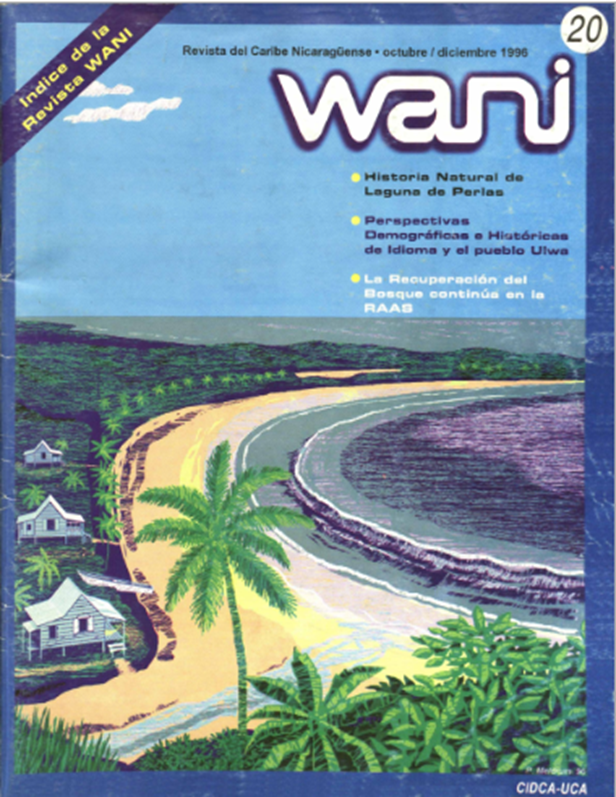
“The Natural History of Pearl Lagoon” is the first scientific article published to date that presents a comprehensive approach to this beautiful area of the RAAS characterized by its ethnic diversity and its complex and delicate biodiversity. The importance of this article lies in the fact that it is the product of an investigation carried out in the Pearl Lagoon watershed, which seeks to ensure community participation in the articulation of a management plan for this watershed. By documenting this process of formation of Pearl Lagoon and its current situation, the authors make available to Nicaraguan university students, especially coastal students, a valuable information base.
Downloads
192
References
Guilfoyle, K. J. (1994). A case study of the effects of human exploitation and hurricane damage upon the mangrove ecosystems of Laguna Perlas, Nicaragua. Undergraduate thesis. Hampshire College, USA.
Hermann, S. M. (1995). Personal communications with research biologist from Tall Timbers, Inc., Tallahassee, FL.
Howard, S. (1993). El caso de la RAAN, autonomía y derechos territoriales indígenas. Wani, 14, 1–17.
Kapetsky, J. M., & Lasserre, G. (Eds.). (1984). Management of coastal lagoon fisheries (Stud. Rev. GFCM, 61). Food and Agriculture Organization.
Kottak, C. P. (1992). Assault of paradise: Social change in a Brazilian village. McGraw Hill, New York.
Leonard, J. (1981). Environmental profile of Nicaragua. USAID Bureau of Science and Technology.
Mallona, M. A. (1992). Impact of Hurricane Joan on sapling survival, growth, and recruitment in the southeast coast of Nicaragua. Master’s thesis, University of Michigan.
McClusky, D. S. (1981). The estuarine ecosystem. John Wiley and Sons, New York.
Murray, S. P., Hsu, S. A., Roberts, H. H., Owens, E. H., & Crout, R. L. (1982). Physical processes and sedimentation on a broad shallow bank. Estuarine, Coastal and Shelf Science, 14, 135–157.
Nietschmann, B. (1973). Between land and water: The subsistence ecology of the Miskito Indians, Eastern Nicaragua. Seminar Press, New York.
Olsen, S., & Foer, G. (1992). An agenda for coastal ecosystems management in Central America. University of Rhode Island.
Parsons, J. J. (1955). The Miskito pine savanna of Nicaragua and Honduras. Annals of the Association of American Geographers, 45, 36–63.
Perfecto, I., Mallona, M. A., Granzow de la Cerda, L., & Vandermeer, J. (1994). Hacia una filosofía de sostenibilidad: los recursos terrestres del Caribe Nicaragüense. Wani, 15, 47–59.
Pons, G. (1970). Ecología humana en Centroamérica. Serie Monografías Técnicas. Organización de Estudios Centroamericanos, San Salvador.
Radley, J. (1960). The physical geography of the East Coast of Nicaragua. Master’s thesis, University of California, Berkeley.
Roberts, H. H., & Murray, S. P. (1983). Controls of reef development and the terrigenous-carbonate interface on a shallow shelf, Nicaragua (Central America). Coral Reefs, 2, 71–80.
Robinson, S. (1991). Diagnóstico preliminar de la situación actual del medio ambiente en la región autónoma sur (RAAS). INDERA, Managua, Nicaragua.
Roth, L. C., & Grijalva, A. (1991). New record of the mangrove Pelliciera rhizophorae on the Atlantic Coast of Nicaragua. Rhodora, 93(874), 183–186.
Ryan, J. (1992). Medioambientes marinos de la Costa Caribe de Nicaragua. Wani, 12, 35–47.
Ryan, J. (1995). Recursos pesqueros y sostenibilidad en el Caribe Nicaragüense. Wani, 16, 5–21.
Schreder, E. (1995). Weed management by traditional farmers: The case of Rocky Point, Nicaragua. Master’s thesis, University of Michigan.
Somarriba, E. L. E., Vega, M. A., Detlefsen, G., Patiño, H., & Twum-Ampofo, K. (1986). Pastoreo bajo plantaciones de Pinus caribaea en Pavones, Turrialba, Costa Rica. El Chasqui (CR), 1(1), 5–8.
Strangeways, T. (1822). Sketch of the Mosquito Shore including the territory of Poyais. W. Blackwood, Edinburgh.
Taylor, B. W. (1962). The status and development of the Nicaraguan pine savannas. Caribbean Forester, 23(2), 1–26.
Vandermeer, J. (1990). Los ecosistemas terrestres de la región de Bluefields, Nicaragua. Reporte para el Centro de Investigaciones y Documentación de la Costa Atlántica (CIDCA), Managua.
Vandermeer, J. (1991). The political ecology of sustainable development: the Southern Atlantic Coast of Nicaragua. Centennial Review, Spring.
Vandermeer, J., & Perfecto, I. (Eds.). (1991). Los bosques de la costa caribeña de Nicaragua: tres años después del huracán Juana. CIDCA, Managua.
Vemooy, R. (1995). Buscando trabajo: historia laboral del litoral Atlántico. Wani, 16, 23–35.
White Hodgson, N. (1983). La mujer en la pesca: el caso de la comunidad de Orinoco. Tesis, Universidad Centroamericana, Managua.
Yih, K., Boucher, D., Vandermeer, J., & Zamora, N. (1991). Recovery of the rain forest of southeastern Nicaragua after the destruction by Hurricane Joan. Biotropica, 23(2).
Downloads
Published
How to Cite
Issue
Section
License
Copyright (c) 2024 Bluefields Indian and Caribbean University

This work is licensed under a Creative Commons Attribution-NonCommercial-ShareAlike 4.0 International License.


