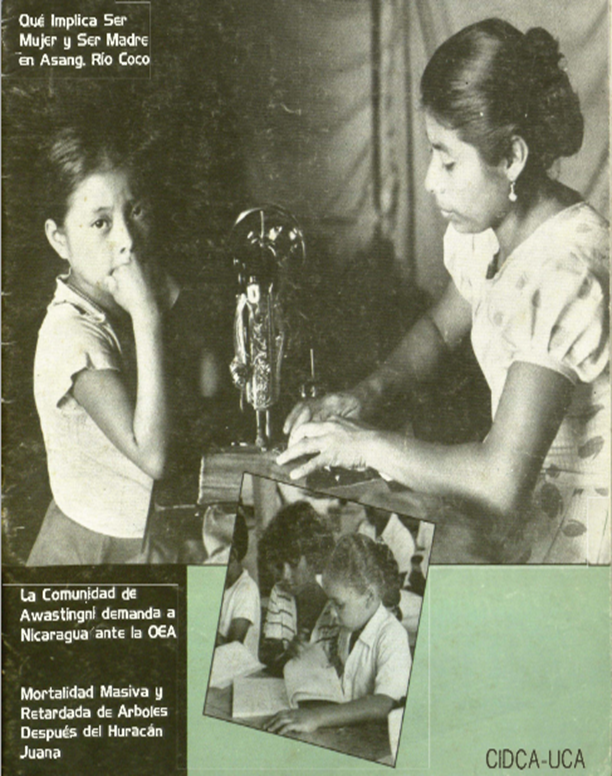
Awastigni community sues Nicaragua before the OAS
Keywords:
Awastingni, Community, Ethnic conflict, Indigenous population, Legislation, Natural resources, Political conflict, Right to propertyAbstract
The article here presented has as its goal to explain the legal basis on which is fundamental the demand of the natural resources and territories occupied by the Mayangna community of Awastingni, located in the North Atlantic Autonomous Region. The author also uses the case of this community Asan illustration of what an interethnic conflict could be like at the national level caused by indigenous peoples in their desperate race to obtain an effective control over their traditional territories and natural resources.
Downloads
315
References
Collins, P. (1994). Shifting the Center: Race, Class and Feminist Theorizing about Motherhood. En D. Bassin et al. (Eds.), Representations of Motherhood. New Haven: Yale University Press.
García, C. (1996). The Making of the Mikitu People of Nicaragua: The Social Construction of Ethnic Identity (Acta Universitatis Upsaliensis, 41). Uppsala: Uppsala University.
Harris, O. (1981). Households as Natural Units. En K. Young et al. (Eds.), Of Marriage and the Market. London: CSE Books.
Helms, M. (1971). Asang: Adaptaciones al Contrato Cultural en una Comunidad Miskita. Instituto Indigenista Interamericano.
Rosaldo, M. Z. (1974). Women, Culture and Society: A Theoretical Overview. En M. Rosaldo & L. Lamphere (Eds.), Women, Culture and Society. Stanford: Stanford University Press.
Stack, C. (1974). All Our Kin: Strategies for Survival in a Black Community. New York: Harper & Row.
Strathern, M. (1980). No Nature, No Culture: The Hagen Case. En C. MacCormack & M. Strathern (Eds.), Nature, Culture and Gender. Cambridge: Cambridge University Press.
Downloads
Published
How to Cite
Issue
Section
License
Copyright (c) 2024 Bluefields Indian and Caribbean University

This work is licensed under a Creative Commons Attribution-NonCommercial-ShareAlike 4.0 International License.


