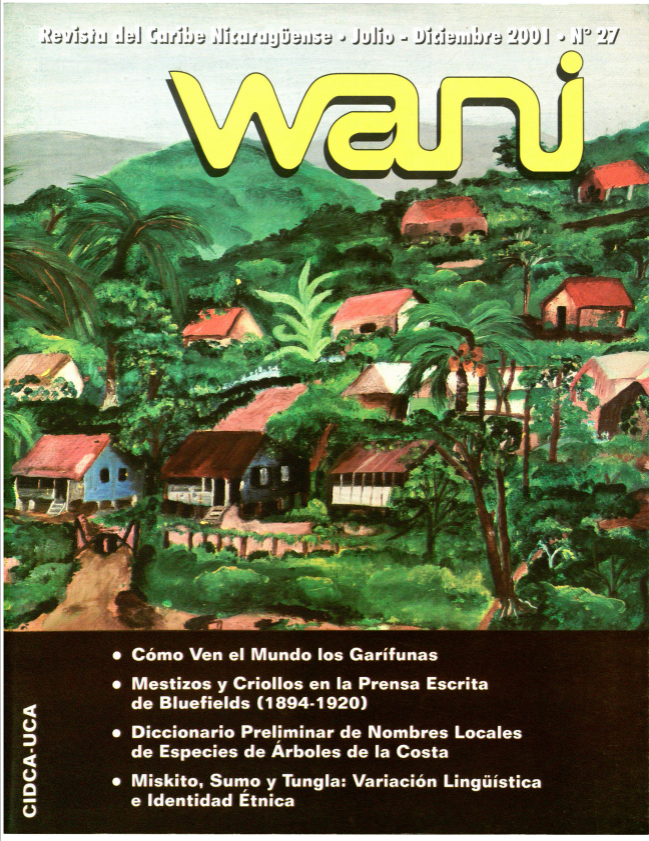
Miskito, sumo y tungla: variación lingüística e identidad étnica
Palabras clave:
Costa Caribe de Nicaragua, Historia, Identidad, Lengua, Población indígenaResumen
Este artículo constituye un esfuerzo para exponer un conjunto de presunciones que han plagado los relatos históricos de la Mosquitia. Estas presunciones conciernen a los diversos pueblos que durante el siglo XIX llegaron a ser conocidos como sumos y sus relaciones con los miskitos. El supuesto que la desaparición de algunos de estos grupos sumos y la decadencia de otros se debió exclusivamente a las incursiones de los miskitos del siglo XVIII debe ser cuestionado. En este escrito, el autor propone una versión modificada de la historia de los sumos. Él cree que muchas comunidades sumas desaparecieron en los siglos XIX y XX debido al cambio de idioma, al convertirse sus miembros en hablantes del Miskito o del español, y consecuentemente, sus comunidades se convirtieron en miskitos o mestizas. Este proceso, según el autor, continúa en el siglo
601
Referencias
Americas Watch. (1987). The Sumos in Nicaragua and Honduras: An endangered people. Americas Watch Committee.
Buvollen, H. P., & Buvollen, H. A. (1994). Demografía de la RAAN. Wani, 15, 5-19.
Bell, C. N. (1862). Remarks on the Mosquito Territory, its climate, people, productions, etc. Journal of the Royal Geographical Society, 32, 242-268.
Bell, C. N. (1989). Tangweera: Life and adventures among gentle savages. University of Texas Press. (Original work published 1899)
Conzemius, E. (1932). Ethnographic survey of the Miskito and Sumo Indians of Honduras and Nicaragua (Bulletin No. 106). U.S. Government Printing Office.
Dampier, W. (1927). A new voyage round the world. The Argonaut Press. (Original work published 1697)
Dennis, P. A., & Olien, M. D. (1984). Kingship among the Miskito. American Ethnologist, 11(4), 718-737. https://doi.org/10.1525/ae.1984.11.4.02a00070
Exquemelin, A. O. (1969). The buccaneers of America. Penguin. (Original work published 1678)
Goldman, I. (1979). The Cubeo: Indians of the Northwest Amazon (2nd ed.). University of Illinois Press. (Original work published 1963)
Goldman, I. (1986). Of kings and contexts: Ethnohistorical interpretations of Miskito political structure and function. American Ethnologist, 13(3), 506-523. https://doi.org/10.1525/ae.1986.13.3.02a00080
Holm, J. A. (1978). The Creole English of Nicaragua's Miskito Coast: Its sociolinguistic history and a comparative study of its lexicon and syntax [Doctoral dissertation, University College London].
Jamieson, M. (1998). Linguistic innovation and relationship terminology in the Pearl Lagoon basin of Nicaragua. Journal of the Royal Anthropological Institute, 4(4), 713-750. https://doi.org/10.2307/3034829
Norwood, S. (1993). El Sumo, lengua oprimida: Habilidades lingüísticas y cambio social: los Sumus. Wani, 14, 53-64.
Mueller, K. A. (1932). Among Creoles, Miskitos and Sumos: Eastern Nicaragua and its Moravian missions. Comenius Press.
M.W. (1732). The Mosqueto Indian and his golden river: A familiar description of the Mosqueto kingdom in America with a relation of strange customs, religion, wars, &c. of those heathenish people. In A. Churchill (Ed.), A collection of voyages and travels (Vol. 6). [Publisher location].
Nietschmann, B. (1973). Between land and water: The subsistence ecology of the Miskito Indians, eastern Nicaragua. Seminar Press.
Noweck, D. (1988). Class, culture, and the Miskito Indians: A historical perspective. Dialectical Anthropology, 13(1), 17-29. https://doi.org/10.1007/BF00252110
Descargas
Publicado
Cómo citar
Número
Sección
Licencia
Derechos de autor 2025 Bluefields Indian and Caribbean University

Esta obra está bajo una licencia internacional Creative Commons Atribución-NoComercial-CompartirIgual 4.0.