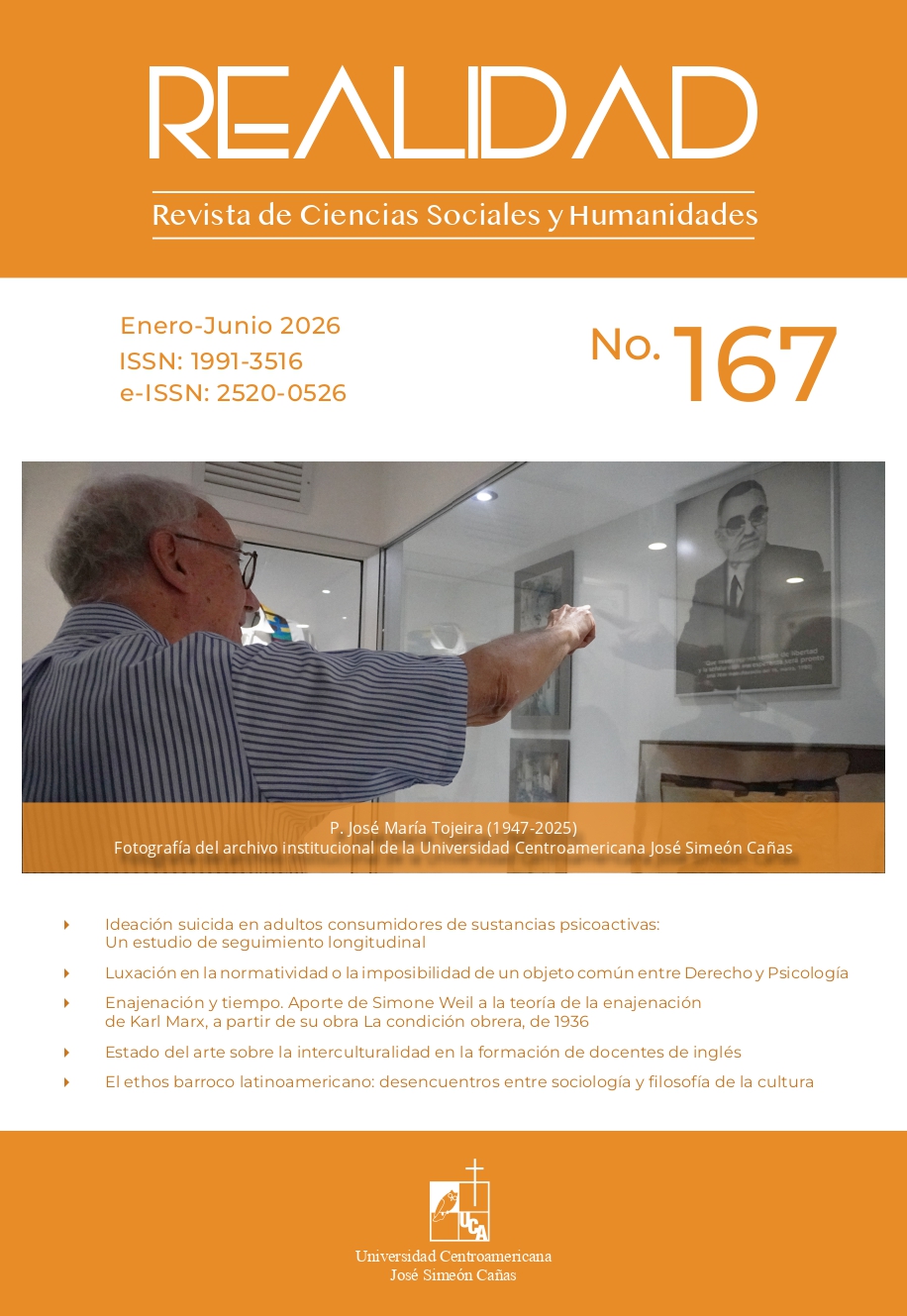
Luxación en la normatividad o la imposibilidadde un objeto común entre Derecho y Psicología
Palabras clave:
Luxación normativa, Daño moral, Psicología jurídica, Conducta, Fractura epistemológicaResumen
Este ensayo examina la fractura epistemológica entre el Derecho y la Psicología en El Salvador, centrando su análisis en cómo ambas disciplinas construyen y operacionalizan el concepto de conducta. Se sostiene que la categoría de daño moral expone una luxación normativa, es decir, una dislocación que impide articular de forma coherente el razonamiento jurídico con la interpretación psicológica. La propuesta central plantea una figura fundante de la conducta, concebida como externalización degradada del fuero interno, capaz de convertirse en objeto medible y operable en el espacio euclidiano de ambas disciplinas. Esta conceptualización busca abrir la posibilidad de una ontología compartida que supere la disparidad discursiva actual. La persistente disociación entre marcos jurídicos y psicológicos en El Salvador no sólo limita la eficacia de la justicia, sino que revela una crisis más profunda en los cimientos simbólicos y prácticos de la acción jurídica. Inspirándose en Hegel, Lacan y la lógica de las ciencias naturales, el ensayo cuestiona la continuidad conceptual entre la conducta como objeto jurídico y como fenómeno psicológico, subrayando que la falta de claridad ontológica produce contradicciones institucionales y tensiones epistémicas. Finalmente, se plantea la necesidad de repensar radicalmente la justicia cuando sus categorías fundantes —daño, responsabilidad y conducta— carecen de base estable y coherente.
Descargas
311
EPUB 68
Citas
Abejión, M. (2017). El concepto de verdad en historia de la locura: Norma y exclusión en relación a la tesis antropológica de Michel Foucault. Revista de Filosofía del Instituto de Investigaciones Filosóficas de la Facultad de Filosofía de la Universidad del Salvador, área San Miguel 7, n.º 9 (junio): 22–44. https://dialnet.unirioja.es/descarga/articulo/6069741.pdf
Aristóteles (1996). Acerca del alma. Alianza Editorial.
Asamblea Legislativa de El Salvador. (2011a). Ley Especial Integral para una Vida Libre de Violencia para las Mujeres. Diario Oficial. https://www.asamblea.gob.sv/sites/default/files/documents/decretos/171117_073006947_archivo_documento_legislativo.pdf
Asamblea Legislativa de El Salvador. (2011b). Ley de Reparación por Daño Moral, Decreto No. 226. Diario Oficial No. 40, tomo 390 (1 de marzo de 2011). https://www.asamblea.gob.sv/sites/default/files/documents/decretos/171117_073640365_archivo_documento_legislativo.pdf
Asamblea Legislativa de la República de El Salvador. (2008). Código Procesal Penal. https://www.oas.org/es/sla/dlc/mesicic/docs/mesicic6_slv_a29.pdf.
Báez, J. (2012). Normalidad, anormalidad y crisis. Tesis Psicológica 7(2), 135–145. https://www.redalyc.org/pdf/1390/139026418011.pdf
Burgos, O. R. (2013). “El factor de atribución en los daños de Internet: ¿riesgo de empresa o principio de conocimiento efectivo?” Derecho y Cambio Social (45), 1–28. https://dialnet.unirioja.es/servlet/articulo?codigo=5496564.
Corte Suprema de Justicia de El Salvador, Sala de lo Civil. (2002). Sentencia, 28 de noviembre de 2002 (ref. 665 Ca. Fam. S. A. IX). https://www.jurisprudencia.gob.sv/DocumentosBoveda/D/1/2000-2009/2002/11/1F49C.PDF.
Corte Suprema de Justicia de El Salvador, Sala de lo Civil. (2015). “Indemnización por daño moral: requiere que se compruebe una afectación o lesión de gravedad a los sentimientos del o la reclamante.”
Ferrater Mora, J. (s. f.) “Adecuado.” En Diccionario de filosofía José Ferrater Mora. Universitat de Girona – Càtedra Ferrater Mora de Pensament Contemporani. Consultado el 1 de mayo de 2025. https://www.diccionariodefilosofia.es/es/diccionario/l/45-adecuado.html.
Hegel, G. W. F. (1993). Fundamentos de la filosofía del derecho. Libertarias Prodhufi.
Heidegger, M. (2002). Interpretaciones fenomenológicas sobre Aristóteles. Trotta.
———. (2013). Carta sobre el Humanismo. Alianza Editorial.
———. (2018). Interpretaciones fenomenológicas sobre Aristóteles. Trotta.
———. (2020). Tiempo e Historia. Trotta.
Kantor, J. (1990). La evolución científica de la psicología. Trillas.
Lacan, Jacques. (2005). Escritos. Buenos Aires: Siglo XXI Editores.
Maya Restrepo, B. E. (2013). No suficiente poâte. Trivium – Estudos Interdisciplinares 5(2), 39–46. http://pepsic.bvsalud.org/scielo.php?script=sci_arttext&pid=S2176-48912013000200006&lng=pt&tlng=e.
Nietzsche, F. (2018). Genealogía de la moral. Edaf.
Peña-Correal, Telmo E., y Robayo-Castro, Beatriz H. (2007). “Conducta verbal de B. F. Skinner: 1957-2007.” Revista Latinoamericana de Psicología 39(3), 653-661. https://pepsic.bvsalud.org/scielo.php?script=sci_arttext&pid=S0120-05342007000300023
Plazas, E. A. (2006). B. F. Skinner: La búsqueda de orden en la conducta voluntaria. Universitas Psychologica, 5(2), 371-384. https://pepsic.bvsalud.org/pdf/up/v5n2/v5n2a13.pdf
Riol Albiac, S. (2020). Psicología y Derecho. Peritos Judiciales Barcelona. https://perito.biz/psicologia-y-derecho/.
Saldaña, A. C. T. (2017). Psicología forense: Casos y modelos de pericias para América Central y del Sur. Ediciones de la U.
Sanz, M. (2016). Heidegger y la fenomenología de la enfermedad. Differenz: Revista internacional de estudios heideggerianos y sus derivas contemporáneas 3(2), 151–166. https://doi.org/10.12795/Differenz.2016.i02.09.
Thurnher, R. (1996). “¡A las cosas mismas!” Acerca de la significación de la máxima fenomenología fundamental en Husserl y Heidegger. Seminarios de Filosofía (9), 29–44. https://dialnet.unirioja.es/servlet/articulo?codigo=144965
Villena Saldaña, D. (2017). ¿Qué es el funcionalismo? Letras, 88(127), 129-155. https://doi.org/10.30920/letras.88.127.6
Publicado
Cómo citar
Número
Sección
Licencia

Esta obra está bajo una licencia internacional Creative Commons Atribución-NoComercial 4.0.
© Realidad: Revista de Ciencias Sociales y Humanidades
Los autores/as que publiquen en esta revista aceptan las siguientes condiciones:
Realidad: Revista de Ciencias Sociales y Humanidades, proporciona acceso abierto e inmediato a su contenido, basados en la Política de Acceso Abierto de la Universidad Centroamericana “José Simeón Cañas”
De acuerdo con la legislación de derechos de autor, Realidad: Revista de Ciencias Sociales y Humanidades, reconoce y respeta el derecho moral de los autores, así como la titularidad del derecho patrimonial, el cual será cedido a la revista para su difusión en acceso abierto en versión impresa y en formato digital. Al formar parte de múltiples indexadores, bases de datos y sistemas de referencia, los artículos que sean publicados por Realidad: Revista de Ciencias Sociales y Humanidades se encontrarán visibles y serán descargados también de estos sitios web, indicando, en todos los casos, la autoría de los artículos, la fecha de publicación y el número de la revista al que corresponden.
La declaración BOAI describe: “Por "Acceso Abierto" a esta literatura, queremos decir su disponibilidad gratuita en Internet público, permitiendo a cualquier usuario leer, descargar, copiar, distribuir, imprimir, buscar o usarlos con cualquier propósito legal, sin ninguna barrera financiera, legal o técnica, fuera de las que son inseparables de las que implica acceder a Internet mismo. La única limitación en cuanto a reproducción y distribución y el único rol del copyright en este dominio, deberá ser dar a los autores el control sobre la integridad de sus trabajos y el derecho de ser adecuadamente reconocidos y citados."
Usted está en libertad de:
- Compartir: copiar y redistribuir el material en cualquier medio o formato
- Adaptar: remezclar, transformar y crear a partir del material
Bajo las siguientes condiciones:
- Reconocimiento: Usted debe darle crédito a esta obra de manera adecuada, proporcionando un enlace a la licencia, e indicando si se han realizado cambios. Puede hacerlo en cualquier forma razonable, pero no de forma tal que sugiera que usted o su uso tienen el apoyo del licenciante.
- Uso no comercial: Usted no puede hacer uso del material con fines comerciales.


