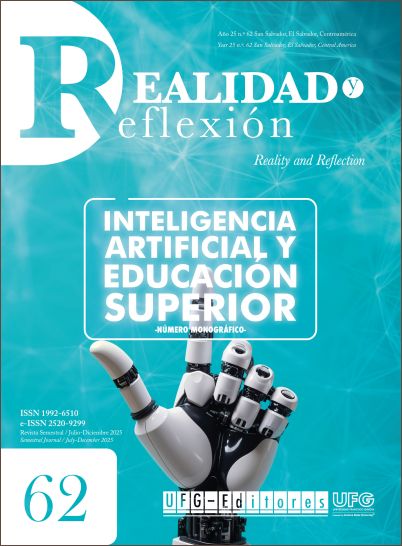
Artificial Intelligence in Salvadoran Higher Education: Ethical and Pedagogical Challenges and Perspectives from Critical Thinking
DOI:
https://doi.org/10.5377/ryr.v1i62.21738Keywords:
artificial intelligence, higher education, critical thinking, salvadoran context, academic integrityAbstract
This essay explores the impact of artificial intelligence (AI) on Salvadoran higher education within a context marked by structural inequalities and digital divides. It examines the main challenges posed by AI in the country’s higher education system, with emphasis on preserving academic integrity, strengthening intellectual authorship, and expanding digital literacy. Currently, the rapid expansion of AI in Salvadoran universities has sparked a debate on the ethical, pedagogical, and formative impact of these technologies, which possess the ability to write texts, answer questions, and solve various tasks. Such tools offer opportunities to enhance teaching and learning processes, as well as to strengthen research. However, their widespread use is often applied without a critical framework, leading to cognitive dependency, the weakening of autonomous thinking, academic plagiarism, and the loss of originality in scientific production—especially when articles or assignments are written using a high percentage of AI-generated text. It should not be forgotten that the Latin American context, and the Salvadoran context in particular, is characterized by digital gaps, socioeconomic inequalities, and limited educational infrastructure. These issues must be addressed by universities, which should also assume an active role in the ethical and reflective formation of students—promoting competencies that allow them to integrate AI as a supportive tool, while fostering creativity, argumentation, and critical judgment, as well as encouraging its ethical, pedagogical, and formative use.
Downloads
934
Downloads
Published
How to Cite
Issue
Section
License

This work is licensed under a Creative Commons Attribution-NonCommercial-ShareAlike 4.0 International License.
© Universidad Francisco Gavidia
Instituto de Ciencia, Tecnología e Innovación (ICTI)
Reality and Reflection
The content and opinions expressed in the publication are the responsibility of the authors of the published articles. The authors assign the publishing and publishing rights, in printed and digital version, to the Universidad Francisco Gavidia.
Proof of originality and assignment of publication rights
The authors must sign a certificate in which they indicate that the text presented for publication is original, unpublished and that it has not been sent for review in another academic publication; In turn, the authors assign the rights of publication and publication to Francisco Gavidia University. The format of this record will be sent through the emails: editores@ufg.edu.sv and jlozano@ufg.edu.sv
The journal Reality and Reflection is housed in the institutional dissemination platforms (web page and in the repository), as well as in databases and other pages of scientific dissemination. The publications of the Francisco Gavidia University are subject to the Salvadoran copyright law, contemplated in the Intellectual Property Law https://www.asamblea.gob.sv/
The content of the work is the sole responsibility of the author, therefore, if for any reason or reason, direct or indirect, the Editor is obliged to pay any compensation to a third party derived from the work of the author, whether it is established in a transaction, agreement or final or enforceable judicial sentence, the Editor may repeat against the Author for the total amount of compensation, plus adjustments, interests and costs that correspond.
It will be the obligation of the UFG to grant five copies of the publication which will be delivered at the UFG Editores headquarters in San Salvador.

