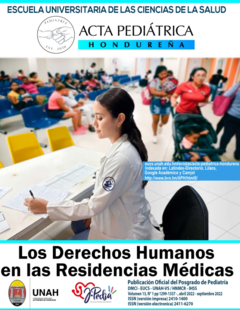
Human Rights in Medical Residencies
Abstract
The editorial examines medical residencies from a human rights perspective, highlighting their historical origins and evolution as a model of specialized training. It emphasizes the close relationship between the right to health and the right to education, as recognized in international declarations such as Alma-Ata and Edinburgh, as well as in global higher education frameworks, which establish the obligation to train highly qualified professionals under principles of dignity and equity.
In the Honduran context, it is stressed that the State, as a signatory to international treaties, has the responsibility to guarantee adequate conditions for the training of medical residents. This includes protection against discrimination, respect for human dignity, and the provision of optimal educational environments, with appropriate infrastructure, qualified faculty, and access to academic resources.
The editorial highlights the absence of a specific legal framework regulating medical residencies, particularly regarding human rights, academic supervision, and working conditions. Critical issues are identified, such as excessive working hours and the imposition of additional on-call duties not included in training programs, which contravene national and international labor standards. These conditions lead to adverse effects, including fatigue, burnout, anxiety, and decreased performance, ultimately compromising both residents’ health and the quality of their training.
Finally, the need to transition toward educational models centered on the resident as an active participant is emphasized, promoting a humanistic pedagogy that ensures respect for their rights and supports the comprehensive training of medical specialists.
Downloads
2