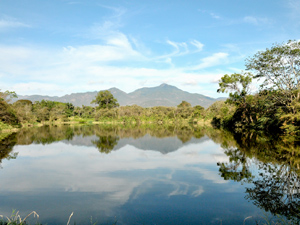
Regeneración natural en sitios impactados por incendios en la Reserva Biológica Uyuca, Honduras.
DOI:
https://doi.org/10.5377/ceiba.v0i0842.5448Abstract
We studied vegetation richness and dominance resulting from natural regeneration in the coniferous forest of the Uyuca Biological Reserve (Francisco Morazán, Honduras) with one (T1), seven (T7) and more than 15 years (T15) after fire disturbance. We established 22 plots per treatment, 11 plots of 1×1 m to sample herbs and tree seedlings and 11 plots of 5×5 m to sample shrubs and vines. We analyzed 3,073 individuals of 79 species in 36 families. The families with more registered genera were Fabaceae and Asteraceae. Lysiloma auritum (Schltdl.) Benth., present only in T1 (97 individuals), was the most common species of herbaceous and seedlings. Morella cerifera (L.) Small was the second most common herbaceous and seedlings species, present in all three treatments. The greatest abundance was found in the category of shrubs and vines such as the fern Pteridium caudatum (L.) Maxon with 484 individuals and Phyla strigulosa (M. Martens & Galeotti) Moldenke with 287 individuals. Mimosa albida Willd. was present in all three treatments; Calliandra houstoniana (Mill.) Standl. although it was not present in T15. In the 5x5 m plots, three Asteraceae were also common: Verbesina agricolarum Standl. & Steyerm. and two species of Calea L. The richness of herbaceous and seedling species was different between the three treatments (χ2= 6.4, P= 0.04) with a higher difference between T1 and T7 (t= -2.37, p= 0.02). The other two sites were similar in species richness. The herbaceous and the tree seedlings had a greater diversity in T1 (H΄ Shannon-Weaver = 2.48), while shrubs and vines were a little more diverse in T15 (H΄= 3.10). The diversity of shrubs and vines was similar in all treatments (χ2= 1.9, P= 0.37). Even more important than similarities or differences among treatments are the species that exist there. Several of these species have very important ecological or use properties for the reserve and for human communities.
Downloads
1422