
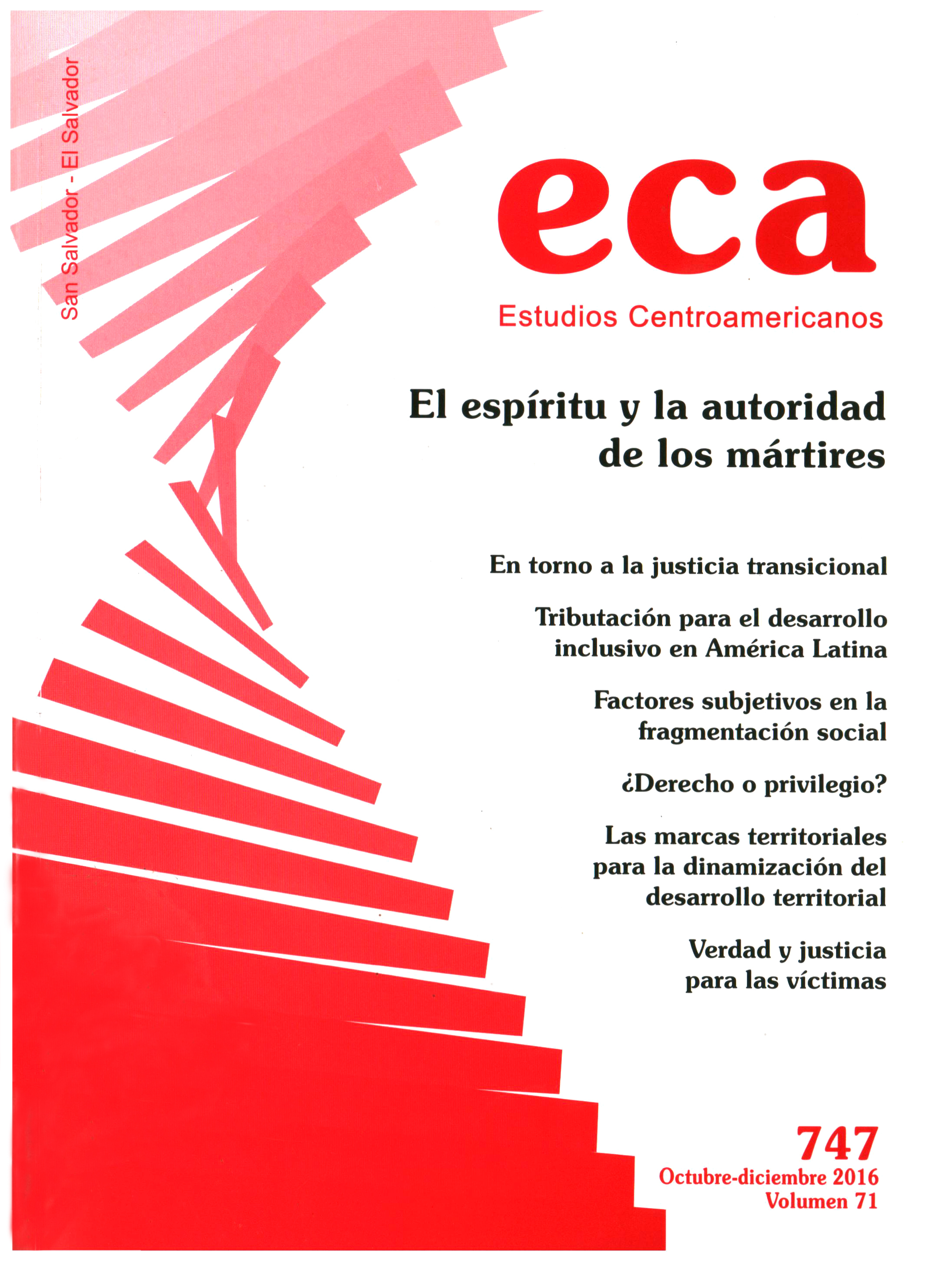
Taxation for Inclusive development in Latin America: a critique of World Bank tax policy
DOI:
https://doi.org/10.51378/eca.v71i747.3202Keywords:
Inclusive development, Progressive taxation, Regressive taxation, World BankAbstract
Inequality and poverty in Latin America are extreme, but there is a solution. The best solution involves an inclusive development process in which the poor participate to the best of their ability and earn the income necessary to live a dignified life. Inclusive development is implemented to provide low-income individuals with the basic goods and services that increase their productivity and, consequently, their opportunities for employment and adequate income. The list of basic goods and services that increase productivity varies depending on circumstances, but a standard list includes education, health care, nutrition, housing, clean water, and sanitation. But how can we raise funds to pay for these services? Progressive taxation offers a solution.
1
References
Bird, Richard (1992). Tax Policy & Economic Development. Baltimore: The Johns Hopkins University Press
(2009a). Taxing Consumption. PREM (Poverty Reduction and Economic Management) Notes: Tax Policy, n.° 136. The World Bank, pp. 1-6. http://www.worldbank.org.
(2009b). The Personal Income Tax. PREM (Poverty Reduction and Economic Management) Notes Tax Policy, n.? 137. The World Bank, pp. 1-6. http://www.worldbank.org.
(2010). Taxation and Development. Economic Premise, n.° 34, The World Bank, pp. 1-5. http://www.worldbank.org.
Deloitte. International Tax Highlights. El Salvador 2014. http://www2.deloitte.com/content/damIDeloitte/globaVDocumentslTax/dttl-tax-elsalvadorhighlights-2014.pdf
Goodreads. March 20, 2014. https://www.goodreads.com/author/quotes/3091287.Thomas_Edison.
Greene, WilIiam H. (2000). Econometric Analysis, 4 th edition. New Jersey: Prentice Hall.
Gutierrez, Mario A. (2004). The Tax System in El Salvador. International Center for Globalization and Development. Working Paper #17. http://www.ciglob.org/inicio/filesIWP%2017.pdf
Hicks, Norman L. & Streeten, Paul (1979). Indicators of Development: The Search for a Basic Needs Yardstick. World Development Vol. 7, pp. 567-580.
Hicks, Norman L. (1982). Sector Priorities in Meeting Basic Needs: Sorne Statistical Evidence. World Development, Vol. 10, No. 6, pp. 489-499.
IBRD (The International Bank for Reconstruction and Development) (1991). Lessons of Tax Reform. Washington, D.C: The World Bank.
IMF Statistics Department (2013). Govemment Finance Statistics Yearbook 2012. Washington, D.C: International Monetary Fund.
Kennedy, Peter (2003). A Guide to Econometrics, 5 th ed. Cambridge, Massachusetts: The MIT Press.
Mankiw, G.N., Weinzierl, M. Yagan, D. (undated). Optimal Taxation in Theory and Practice. http://scholar.harvard.edu/files/mankiw/files/optimal_taxation_in_theory.pdf (Retrieved 3/21/20-14).
McGuire, J. Michael (2009). Descentralización para satisfacer necesidades básicas: una guía económica para profesionales. Charlotte, North Carolina: Information Age Publishing, Inc.
McGuire, J. M. (1990). Los cambios de la estructura tributaria de El Salvador: implicaciones para el desarrollo. San Salvador, Universidad Centroamericana José Simeón Cañas: Realidad Económico-Social, año 111, n.° 18.
Musgrave, RA. y Musgrave, PB. Public Finance in Theory and Practice, 5th ed. Mexico: McGraw-HilI Book Company.
Piketty, Thomas (2014). Capital in the Twenty First Century. Cambridge, Massachusetts: The Belknap Press of Harvard University Press.
Pita, C. (1993). La reforma tributaria en América Latina en la década de los años 80: efectos de suficiencia, equidad, neutralidad y simplificación. Washington, D. C.: Banco Interamericano de Desarrollo
Streeten, P. et al. (1981). First Things First: Meeting Basic Human Needs in Developing Countries. New York: Oxford University Press. Published for the World Bank.
Studenmund, A. H. (2011). Using Econometrics: A Practical Guide, 6th ed. New York: Addison-Wesley.
Thirsk, Wayne, ed. (1997). Tax Reform in Developing Countries. Washington, D. C.: The World Bank.
UNDP (United Nations Development Program). Human Development Report, various issues. http://www.undp.orglcontent/undp/en/home/Iibrarypage/hdr/
Wooldridge, Jeffrey M. (2013). Introductory Econometrics: A Modern Approach, 5th ed. Mason, Ohio: South-Western Cengage Learning.
World Bank (1991). Lessons of Tax Reform. Washington, D.C. The World Bank.
World Bank. World Development Indicators. http://databank.worldbank.orgldata.aspx.
Downloads
Published
How to Cite
Issue
Section
License

This work is licensed under a Creative Commons Attribution-NonCommercial-NoDerivatives 4.0 International License.
© ECA. Estudios Centroamericanos está bajo una licencia Creative Commons NonCommercial-NoDerivatives 4.0 International (CC BY-NC-ND 4.0).

La licencia no comercial y sin obra derivada permite la reproducción, distribución y comunicación pública, pero no la posibilidad de comercializar su contenido ni tampoco generar una obra derivada, como una traducción o adaptación, excepto que se pida permiso a los editores de dicha obra.
En ese sentido, se está en la libertad de:
Compartir: copiar y redistribuir el material en cualquier medio o formato.
Bajo las siguientes condiciones:
- Reconocimiento: se debe dar crédito a esta obra de manera adecuada, proporcionando un enlace a la licencia, e indicando si se han realizado cambios.
- Uso no comercial: no se puede hacer uso del material con fines comerciales.
- Sin obra derivada: si se remezcla, transforma o construye sobre ese material, no se puede distribuir el material modificado.

