
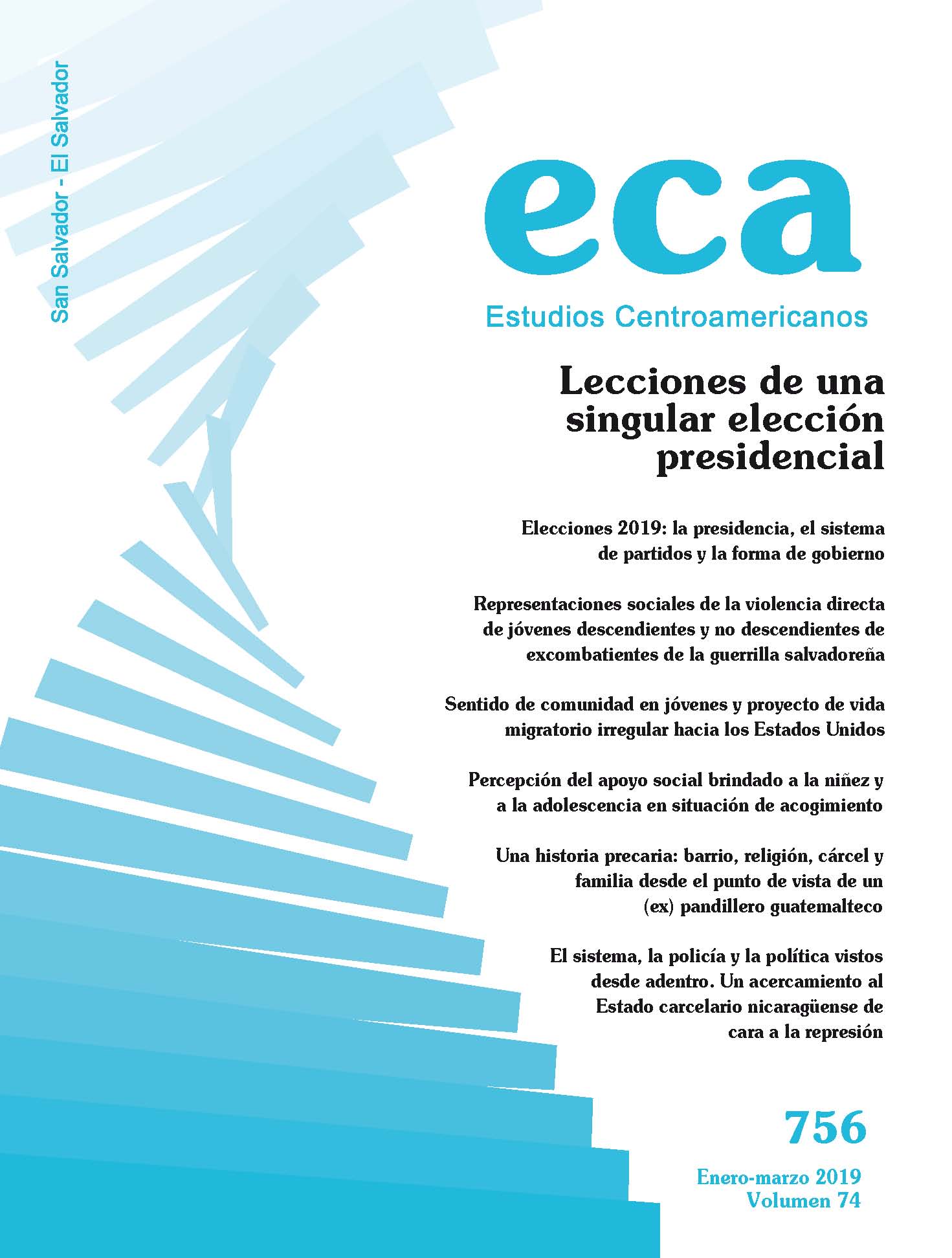
A precarious history: neighborhood, religion, prison and family from the point of view of a (ex) Guatemalan gang member
DOI:
https://doi.org/10.51378/eca.v74i756.3151Keywords:
Ethnography, Guatemala City, Gangs, Life storiesAbstract
Drawing on an extensive interview with Mike (a pseudonym)—a former Barrio 18 gang member released from a Guatemalan prison in February 2011—this article will discuss four main themes: Mike’s strained relationship with his neighborhood and with the new generations of gang members living there; the role of religion in the only viable strategy for attempting social rehabilitation and a possible, though always uncertain, “reintegration”; the role of prison in this process of identity reconfiguration; and his family, his daughters, and his future. This article will give space to Mike’s “stream of consciousness,” interspersing his words with only a few narrative bridges and some necessary contextualizations.
0
References
Althabe, G. (1969). Oppression et liberation dans l’imaginaire. Les communautés villageoises de la côte orientale de Madagascar. París: Maspero.
Bourgois, P. (1995). In Search of Respect: Selling Crack in El Barrio. Cambridge: Cambridge University Press.
Brenneman, R. (2011). Homies and Hermanos. God and Gangs in Central America. Oxford, NY: Oxford University Press.
CIA. (2019). The World Factbook. Central America. Guatemala. Recuperado de https://www.cia.gov/library/publications/the-world-factbook/geos/gt.html.
Covey, H. C., Menard, S. & Franzese, R. J. (1997). Juvenile Gangs. Springfield, IL: Charles C. Thomas.
Cruz, J. M. (Ed.) (2006). Maras y pandillas en Centroamérica. Las respuestas de la sociedad civil organizada, IV. Managua: UCA.
Demoscopía, S. A. (2007). Maras y pandillas, comunidad y policía en Centroamérica, Guatemala: ASDI, BCIE.
ERIC, DIRINPRO, NITLAPÁN, IDIES e IUDOP. (2004). Maras y pandillas en Centroamérica. Políticas juveniles y rehabilitación. Vol. III. Managua: UCA.
Fontes, A.W. (2018). Mortal Doubt: Transnational Gangs and Social Order in Guatemala City. Oakland, CA: University of California Press.
Grassi, P. (2015). Il limbo urbano. Conflitti territoriali, violenza e gang a Città del Guatemala. Verona: Ombre corte.
Hagedorn, J. (1998). People and Folks: Gangs, Crime and the Underclass in a Rustbelt City. Chicago: Lakeview Press.
Hagedorn, J. (1999). A World of Gang. Armed Young Men and Gangsta Culture. Mineápolis: University of Minnesota Press.
Hazen J. M. & Rodgers, D. (Eds.). (2014). Global Gangs. Street Violence across the World. Mineápolis: University of Minnesota Press.
Insight Crime & Center for Latin American & Latino Studies (CLALS). (2018). MS13 in the Americas. How the World’s Most Notorious Gang Defies Logic, Resists Destruction. Recuperado de https://www.insightcrime.org/wp-content/uploads/2018/02/MS13-in-the-Americas-InSight-Crime-English-3.pdf.
Levenson, D. (1988). Por sí mismo. Un estudio preliminar de las “maras” en la ciudad de Guatemala. Guatemala: AVANCSO.
O’Neill, K. L. (2015). Secure the Soul. Christian Piety and Gang Prevention in Guatemala. Oakland, CA: University of California Press.
Procuraduría de los Derechos Humanos (PDH). (2006). Observatorio guatemalteco de cárceles. Segundo informe. Guatemala: Autor.
Programa de las Naciones Unidad para el Desarrollo (PNUD). (2015). Documento del programa para Guatemala (2015-2019). Guatemala: Autor.
Rodgers, D. (2009). Slum wars of the 21st century: Gangs, Mano Dura, and the new urban geography of conflict in Central America. Development and Change, 40(5), pp. 949-976. Recuperado de https://core.ac.uk/download/pdf/96042.pdf.
World Prison Brief. (2018). World Prison Brief data. Guatemala. Recuperado de http://www.prisonstudies.org/country/guatemala.
Downloads
Published
How to Cite
Issue
Section
License

This work is licensed under a Creative Commons Attribution-NonCommercial-NoDerivatives 4.0 International License.
© ECA. Estudios Centroamericanos está bajo una licencia Creative Commons NonCommercial-NoDerivatives 4.0 International (CC BY-NC-ND 4.0).

La licencia no comercial y sin obra derivada permite la reproducción, distribución y comunicación pública, pero no la posibilidad de comercializar su contenido ni tampoco generar una obra derivada, como una traducción o adaptación, excepto que se pida permiso a los editores de dicha obra.
En ese sentido, se está en la libertad de:
Compartir: copiar y redistribuir el material en cualquier medio o formato.
Bajo las siguientes condiciones:
- Reconocimiento: se debe dar crédito a esta obra de manera adecuada, proporcionando un enlace a la licencia, e indicando si se han realizado cambios.
- Uso no comercial: no se puede hacer uso del material con fines comerciales.
- Sin obra derivada: si se remezcla, transforma o construye sobre ese material, no se puede distribuir el material modificado.

