
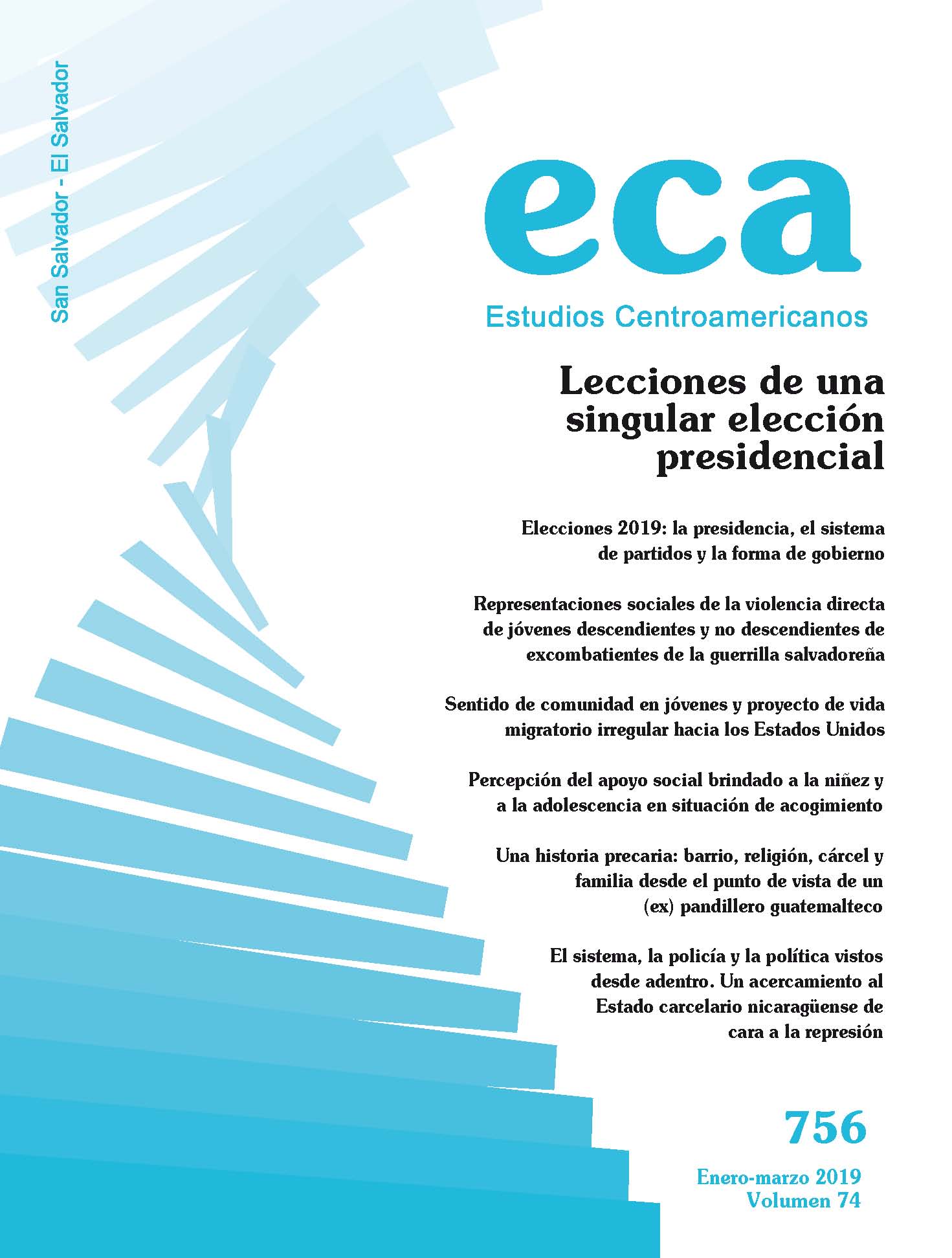
Elections 2019: the presidency, the party system and the form of government
DOI:
https://doi.org/10.51378/eca.v74i756.3146Keywords:
Presidents, Elections, Political parties, El SalvadorAbstract
There are several reasons to believe that the 2019 elections were exceptional. First, they took place amid unprecedented allegations of fraud and mistrust of the electoral authority. Second, the winning candidate was not affiliated with the parties that had controlled the executive branch since 1989 and dominate the legislative arena. Third, the elections introduced a factor of political moderation that disrupted the prevailing strategy of polarization. Fourth, the result places the country at a crossroads between strengthening authoritarian patterns in the exercise of power or democratic patterns with oversight of officials. And fifth, the president-elect assumes office under a configuration that will characterize him as an institutionally weak leader, albeit one with strong popular support, at least at the start of his term. A more detailed examination of these five reasons constitutes the content of this paper. Beyond addressing concerns related to the post-election situation, this paper aims to open a line of research on one of the fundamental institutions of El Salvador’s system of government: the presidency.
0
References
Alessandro, M., Lafuente, M. y Santiso, C. (2013). El fortalecimiento del Centro de Gobierno en América Latina y el Caribe. Recuperado de https://www.iadb.org/es/centrodegobierno.
Artiga-González, Á. (2015). El sistema político salvadoreño. San Salvador: Programa de Naciones Unidas para el Desarrollo (PNUD)-El Salvador.
Artiga-González, Á. (2000). La política y los sistemas de partidos en Centroamérica. San Salvador: FundaUngo.
UCA (2018). ¡No nos dejes caer en la tentación y líbranos del mal! Estudios Centroamericanos (ECA), 73(754), pp. 237-244. San Salvador: Autor.
IUDOP (2018a). Los salvadoreños y salvadoreñas evalúan la situación del país a finales de 2018 y opinan sobre las elecciones presidenciales de 2019. Boletín de Prensa, XXXII(4). San Salvador: Autor.
IUDOP (2018b). Evaluación del país a finales de 2017 y perspectivas electorales para 2018. Boletín de Prensa, XXXII(1). San Salvador: Autor.
IUDOP (2018c). Encuesta de evaluación del cuarto año de Gobierno de Salvador Sánchez Cerén, Asamblea Legislativa, Corte Suprema de Justicia y evaluación poselectoral. Serie de Informes, 145. San Salvador: Autor.
IUDOP (2017). Los salvadoreños evalúan el tercer año de gobierno de Salvador Sánchez Cerén. Boletín de Prensa, XXXI(3). San Salvador: Autor.
IUDOP (2014). Los salvadoreños y salvadoreñas frente a las elecciones presidenciales de 2014. Boletín de Prensa, XXVIII(1). San
Salvador: Autor.
IUDOP (2009). Los salvadoreños y salvadoreñas frente a las elecciones presidenciales de 2009. Boletín de Prensa, XXIV(1). San Salvador: Autor.
IUDOP (2004a). Los salvadoreños frente a las elecciones presidenciales de 2004. Boletín de Prensa, XIX(1). San Salvador: Autor.
IUDOP (2004b). Los salvadoreños evalúan la situación del país a finales de 2004. Boletín de Prensa, XIX(5). San Salvador: Autor.
IUDOP (2003). Encuesta preelectoral de febrero de 2003. Base de datos SPSS. San Salvador: Autor.
IUDOP (1999). Encuesta sobre el proceso electoral de 1999. Serie de Informes, 73. San Salvador: Autor.
IUDOP (1994). La opinión de los salvadoreños sobre las elecciones. La última encuesta pre-electoral de 1994. Serie de Informes, 39. San Salvador: Autor.
Laakso, M. y Taagepera, R. (1979). “Effective” Number of Parties. A Measure with Application to West Europe. Comparative Political Studies, 12(1), pp. 3-27. Recuperado de https://escholarship.org/uc/item/703827nv.
Rosales Plaza, F. (2014). El diseño del Centro de Gobierno latinoamericano: un análisis comparado del rol de la presidencia. Tesis de Magíster en Gestión y Políticas Públicas, Universidad de Chile.
Sartori, G. (1992). Partidos y sistemas de partidos. Madrid: Alianza.
Downloads
Published
How to Cite
Issue
Section
License

This work is licensed under a Creative Commons Attribution-NonCommercial-NoDerivatives 4.0 International License.
© ECA. Estudios Centroamericanos está bajo una licencia Creative Commons NonCommercial-NoDerivatives 4.0 International (CC BY-NC-ND 4.0).

La licencia no comercial y sin obra derivada permite la reproducción, distribución y comunicación pública, pero no la posibilidad de comercializar su contenido ni tampoco generar una obra derivada, como una traducción o adaptación, excepto que se pida permiso a los editores de dicha obra.
En ese sentido, se está en la libertad de:
Compartir: copiar y redistribuir el material en cualquier medio o formato.
Bajo las siguientes condiciones:
- Reconocimiento: se debe dar crédito a esta obra de manera adecuada, proporcionando un enlace a la licencia, e indicando si se han realizado cambios.
- Uso no comercial: no se puede hacer uso del material con fines comerciales.
- Sin obra derivada: si se remezcla, transforma o construye sobre ese material, no se puede distribuir el material modificado.

