
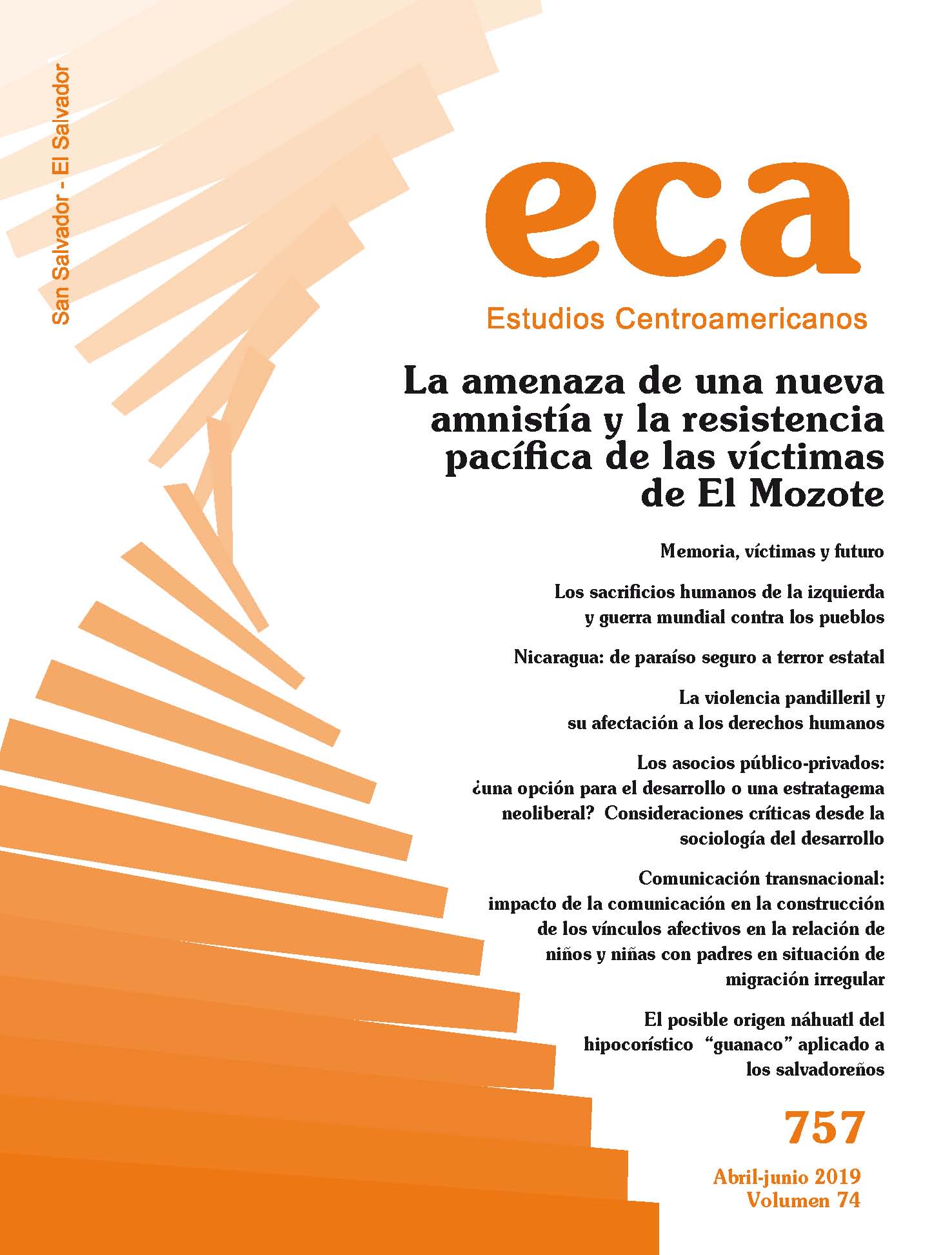
The Public-private partnerships: an option for development or a neoliberal strategy?. Critical considerations from the sociology of development
DOI:
https://doi.org/10.51378/eca.v74i757.3141Keywords:
Public-private partnership, Decentralization, Privatization, State-Society Relations, Development, NeoliberalismAbstract
This paper discusses the equity dimension of partnerships between vulnerable communities, local governments, and private-sector companies—partnerships that aim to provide basic services and infrastructure. It also examines the conditions necessary to meet the expectations of vulnerable social groups regarding these partnerships, as well as the critical role the state plays in intervening in this process. In the context of peripheral countries, the article focuses on the conceptual inconsistencies surrounding public-private partnerships that lead to outcomes opposite to those supposedly intended. It also highlights the ambivalent and deceptive nature of such partnerships, which, when operating effectively, enable a form of disguised privatization that benefits the interests of the private sector and the market, under the guise of sharing power with the state and vulnerable communities.
0
References
Agrawal, A. & Ribot, J. (1999). Accountability in decentralization: a framework with South Asian and West Africa Cases. Journal of Developing Studies Areas, 33, pp. 473-502. Recuperado de https://www.files.ethz.ch/isn/30001/2000-01.pdf.
Batley, R. (1996). Public-private relationships and performance in service provision. Urban Studies, 33(4-5), pp. 723-751. Recuperado de http://citeseerx.ist.psu.edu/viewdoc/download?-doi=10.1.1.875.9854&rep=rep1&-type=pdf.
Bayliss, K. & Fine, B. (Eds.). (2008). Privatization and alternative public sector reform in Sub-Saharan Africa. Londres: Palgrave McMillan.
Beauregard, R. (1998). Public-private partnership as historical chameleons: The case of the United States, en Pierre, J. (Ed.). Partnerships and in urban governance: European and American experiences. Nueva York: Palgrave.
Bennet, A. (1998). Sustainable public-private partnerships for public service delivery. Natural Resources Forum, 22(3), pp. 193-199. Recuperado de https://onlinelibrary.wiley.com/doi/epdf/10.1111/j.1477-8947.1998.tb00728.x.
Bennet, R. (1990). Descentralization, local government and markets: Towards a post-welfare agenda. Oxford: Clarendon.
Bond, P. (2000). Elite transition: From apartheid to neoliberalism in South Africa. Londres: Pluto Press.
Burki, S., Guillermo, P. y Dillinger, W. (1990). Beyond the Center: Decentralizing the state. Washington, D. C.: World Bank.
Cheema, G. S. y Wards, E. (1993). Urban Management: Policy and Innovation in developing countries. Londres: Praeger.
Chambers, R. (1997). Whose reality counts? Putting the first last. Londres: Intermediate Technology Publications.
Cheru, F. (1997). Civil society and political economy in South and Southern Africa, en Gill, S. (Ed.). Globalization, democratization and multilateralism (pp. 219-244). Nueva York: Palgrave MacMillan.
Crewe, E. & Harrison, E. (1998). Whose development? An ethnography of aid. Londres: Zed Books.
Escobar, A. (1997). The making and unmaking of the third world through development, en Rhanema, M. & Bawtree, V. (Eds.). The post development reader. Londres: Zed Books.
Esteva, G. & Prasak, M. (1997). From global thinking to local thinking, en Rhanema, M. & Bawtree, V. (Eds.). The post development reader. Londres: Zed Books.
Forrest, R. (1991). The privatization of collective consumption, en Gottdiener, M. & Pickavance, Ch. (Ed.). Urban Life in transition. Newbury Park, CA: Sage.
Fox, J. (1997). How does civil society thicken? The political construction of social capital in rural Mexico, en Evans, P. (Ed.). Statesociety synergy: Government and social capital in development (pp. 119-149). Berkeley: University of California Press.
Friedmann, J. (1992). Empowerment: The politics of alternative development. Cambridge: Blackwell.
George, S. (1997). How the poor develop the rich, en Rhanema, M. & Bawtree, V. (Eds.). The post development reader. Londres: Zed Books.
Hall, D. (2014). Why Public-Private Partnership don’t work. The many advantages of public alternatives. Research Report. Londres: Universidad de Greenwich. Recuperado de http://biblioteca.semarnat.gob.mx/janium/Documentos/Ciga/Libros2013/CD0029713.pdf.
Heller, P. (2001). Moving the state: the politics of decentralization in Kerala, South Africa and Porto Alegre. Politics and Society, 29(1), pp. 131-165. Recuperado de https://pdfs.semanticscholar.org/3184/ad6cd-31330b8b633418e76d32b0ccb1cac9f.pdf.
International Monetary Fund (IMF). (Fondo Monetario Internacional, FMI). (2004). Public-private partnership. Report by the Fiscal Affair Department. Washington, D. C.: Autor.
Independent Evaluation Group (IEG). World Bank Group Support to public private partnership: Lessons from experience in client countries. Washington, D. C.: World Bank.
Jessop, B. (1994). Post-Fordism and the state, en Amin, A. (Ed.). Post-Fordism: A Reader (pp. 257-279). Oxford: Blackwell.
Kaul, M. (1997). The New Public Administration: management innovations in government. Public Administration and Development, 17(1), pp. 13-26. Recuperado de https://onlinelibrary.wiley.com/doi/epdf/10.1002/%28SICI%291099-162X%28199702%2917%3A1%3C13%3A%3AAID-PAD909%3E3.0.CO%3B2-V.
Kessides, I. (2004). Reforming infrastructure: Privatization, regulation and competition. Washington, D. C.: World Bank.
Mohan, G. & Stokke, K. (2000). Participatory development and empowerment: the danger of localism. Third World Quarterly, 21(2), pp. 247-268. Recuperado de https://www.jstor.org/stable/3993419?seq=1#page_scan_tab_contents.
Moore, D. (2001). Neoliberal globalization and the triple crisis of ‘modernisation’ in Africa: Zimbabwe, the Democratic Republic of the Congo and South Africa. Third World Quarterly, 22(6), pp. 909-929. Recuperado de https://www.tandfonline.com/doi/pdf/10.1080/01436590120099713?needAccess=true.
Osborne, D. & Gaebler, T. (1992). Reinventing government: How the entrepreneurial spirit is transforming the public sector. Reading, MA: Addison-Wesley.
Osborne, S. (2000). Public-private partnership for public services: An international perspective. Londres: Routledge.
Parnell, S. & Pieterse, E. (2002). South African reconstruction: Making developmental local government work. Cape Town: University of Cape Town Press.
Peterson, G. (1997). Decentralization in Latin America: Learning through Experience. Washington, D.C.: World Bank. Recuperado de http://documents.worldbank.org/curated/en/310921468753023954/pdf/multi-page.pdf.
Petras, J. & Veltmeyer, H. (2001). Globalization Unmasked: Imperialism in21st Century. Londres: Zed Books.
Plane, P. (1999). Privatization, Technical Efficiency and Welfare Consequences: The Case of the Côte d’Ivoire Electricity Company (CIE). World Development, 27(2), pp. 343-360.
Romero, M. J. (2015). What lies beneath? A critical assessment of PPPs and their impact on sustainable development. Bruselas: Eurodad. Recuperado de https://eurodad.org/files/pdf/1546450-what-lies-beneath-a-critical-assess-ment-of-ppps-and-their-impact-on-sustainable-development-1450105297.pdf.
Rondinelli, D. & Cheema, S. (1983). Implementing decentralization policies: An introduction, en Rondinelli, D. & Cheema, S. Decentralization and development: Policy implementation in developing countries. Beverly Hills, CA: Sage.
Sclar, E. (2000). You Don’t Always Get What You Pay For. The Economics of Privatization. Ithaca, NY: Cornell University Press.
Shirley, M. & Walsh, P. (2000). Public versus Private Ownership. The Current State of the Debate. Policy Research Working Paper 2420. Washington, D. C.: World Bank. Recuperado de http://documents.worldbank.org/curated/en/952171468766218935/pdf/multi-page.pdf.
Schmitz, G. (1995). Democratization and Demystification: Deconstructing ‘Governance’ as Development Paradigm, en Moore, D. & Schmitz, G. (Eds.). Debating Development Discourse (pp. 54-90). Londres: Palgrave MacMillan. Recuperado de https://link.springer.com/chapter/10.1007%2F978-1-349-24199-6_2.
Squires, G. (1991). Partnership and the pursuit of the private city, en Gottdiener, M. & Pickvance, Ch. (Eds.). Urban Life in Transition. Newbury Park: Sage.
United States Agency for International Development (USAID). (1997). New partnership initiative: A strategic approach in development partnership. Washington, D.C.: Autor.
Wallerstein, I. (2004). World-Systems Analysis: An Introduction. Durham: Duke University Press.
World Bank (Banco Mundial, BM). (1981). Accelerated Development in Sub-Saharan Africa. An Agenda for Action. Washington, D. C.: Autor. Recuperado de http://documents.worldbank.org/curated/en/702471468768312009/pdf/multi-page.pdf.
World Bank (Banco Mundial, BM). (1997). Advancing Sustainable Development. The World Bank and Agenda 21. Washington, D. C.: Autor. Recuperado de http://documents.worldbank.org/curated/en/519871468740215287/pdf/multi-page.pdf.
Downloads
Published
How to Cite
Issue
Section
License

This work is licensed under a Creative Commons Attribution-NonCommercial-NoDerivatives 4.0 International License.
© ECA. Estudios Centroamericanos está bajo una licencia Creative Commons NonCommercial-NoDerivatives 4.0 International (CC BY-NC-ND 4.0).

La licencia no comercial y sin obra derivada permite la reproducción, distribución y comunicación pública, pero no la posibilidad de comercializar su contenido ni tampoco generar una obra derivada, como una traducción o adaptación, excepto que se pida permiso a los editores de dicha obra.
En ese sentido, se está en la libertad de:
Compartir: copiar y redistribuir el material en cualquier medio o formato.
Bajo las siguientes condiciones:
- Reconocimiento: se debe dar crédito a esta obra de manera adecuada, proporcionando un enlace a la licencia, e indicando si se han realizado cambios.
- Uso no comercial: no se puede hacer uso del material con fines comerciales.
- Sin obra derivada: si se remezcla, transforma o construye sobre ese material, no se puede distribuir el material modificado.

