
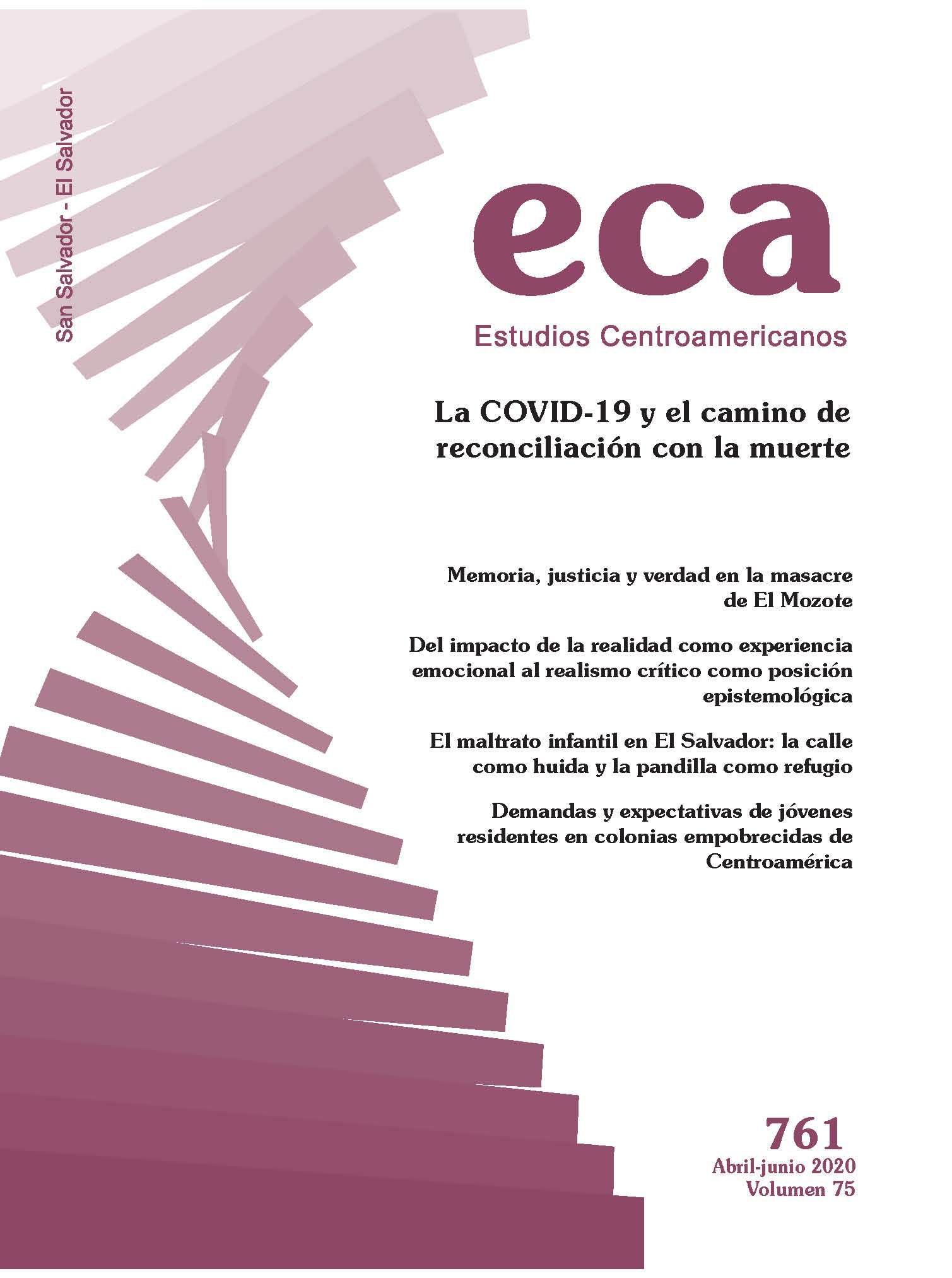
Demands and expectations of young residents in impoverished colonies of Central America
DOI:
https://doi.org/10.51378/eca.v75i761.3306Keywords:
Central America, Youth, Violence, Political culture, Inequalities, MigrationAbstract
This article analyzes demands and expectations of young residents of impoverished neighborhoods in Central American capital cities. Four main subject areas are explored: the representation of the local and national environment, demands and desires for the future, the means by which young people expect to achieve (or not achieve) said demands, and sociodemographic factors. The selected neighborhoods were El Limón in Guatemala City, Popotlán in San Salvador, Nueva Capital in Tegucigalpa, Jorge Dimitrov in Managua, and La Carpio in San José. A sample of 300 respondents were selected using sampling quotas. One of the primary findings of the study is that 37.7% of participants neither study nor work and that only 15% have access to social security. Although inequality was not identified as being among the most pressing problems, when asked about the distribution of wealth in their respective countries, 73.6% of participants considered said distribution to be “very unfair” or “unfair”. This recognition of inequality coexists with a deeply rooted conservatism and a largely unquestioned belief in the legitimacy of destiny and parental authority. The electoral cycle that began in Honduras in 2017 and concluded in Guatemala in 2019 is far from offering any kind of significant or profound response. This electoral cycle has deepened the institutional void, and in many cases immigration has become more of an obligation than a choice.
27
References
S. a. (1987). Procedimiento para establecer la paz firme y duradera en Centroamérica (Acuerdo de Esquipulas II, 7 de agosto de 1987). Relaciones Internacionales, 19(1), 97-102. https://www.revistas.una.ac.cr/index.php/ri/article/view/7311
Adorno, T. W., Frenkel-Brunswick E., Levinson, D. J. y Sanford, R. N. (1959). The Authoritarian Personality. Harper.
Amarante, V., Galbán M. y Mancero, X. (2016). Desigualdad en América Latina: una medición global. Revista CEPAL, 118, 27-47. https://repositorio.cepal.org/bitstream/handle/11362/40024/1/RVE118_Amarante.pdf
Asmann, P. (4 de mayo de 2017). Proyecto de ley antipandillas en Guatemala, ¿otra política fallida de ‘mano dura’? InSight Crime. https://es.insightcrime.org/noticias/noticias-del-dia/proyecto-ley-antipandillas-guatemala-otra-fallida-politica-mano-dura/
Batthyány, K., Sol Cabrera, M., Dede, G. Macadar, D. y Pardo, I. (2005). Género y pobreza: un caso de desigualdades entrelazadas. En Informe Social Watch 2005: Rugidos y susurros. http://www.socialwatch.org/sites/default/files/pdf/es/generopobreza2005_esp.pdf
Bourdieu, P. (1990). Sociología y cultura. Editorial Grijalbo.
Duarte, K. (2000). ¿Juventud o juventudes? Acerca de cómo mirar y remirar a las juventudes de nuestro continente. Última década, 8(13), 59-77. https://scielo.conicyt.cl/scielo.php?script=sci_arttext&pid=S0718-22362000000200004
Fraser, N. (2013). The Fortunes of Feminism. Verso.
Gutiérrez, D. (27 de febrero de 2016). El Salvador: Por qué la guerra social es una guerra. La Haine. https://www.lahaine.org/mm_ss_mundo.php/el-salvador-por-que-la
Hall, S. (2010). Sin garantías. Trayectorias y problemáticas en Estudios Culturales. En E. Restrepo et al. Envión Editores.
Hansen-Nord, S. N., Kjaerulf, F., Almendarez, J., Morales Rodas, V. & Castro, J. (2016). Reducing violence in poor urban areas of Honduras by building community resilience through community-based interventions.
International Journal of Public Health, 61(8), 935-943. https://econpapers.repec.org/article/sprijphth/v_3a61_3ay_3a2016_3ai_3a8_3ad_3a10.1007_5fs00038-016-0854-4.htm
Hernández, R., Fernández, C. y Baptista, P. (2014). Metodología de la investigación. McGraw-Hill.
Hill Collins, P. y Bilge S. (2016). Intersectionality. Polity.
Lechner, N. (1990). Los patios interiores de la democracia. Subjetividad y política. FCE.
Margulis, M. (Ed.). (1996). La juventud es más que una palabra. Ensayos sobre cultura y juventud. Biblos.
Martín Baró, I. (1989). Sistema, grupo y poder. UCA editores.
Pérez Sáinz, J. P. (2012). Exclusión social. Una propuesta crítica para abordar las carencias sociales en América Latina. En Sociedades fracturadas. La exclusión social en Centroamérica. FLACSO.
Pérez Sáinz, J. P. (2019). La rebelión de los que nadie quiere ver. Respuestas para sobrevivir a las desigualdades extremas en América Latina. Siglo XXI FLACSO Costa Rica.
Programa Estado de la Nación en Desarrollo Humano Sostenible. (2016). Cuarto Informe Estado de la Región. PEN.
Sala de lo Constitucional. (2017). Amparo 411-2017, El Salvador. http://www.csj.gob.sv/Comunicaciones/2018/07_JULIO/COMUNICADOS/Amp.%20411-2017%20Sentencia%20desplazamiento_7MZT.pdf
Sandoval, C. et al. (2010). Un país fragmentado. La Carpio: Cultura, comunidad y política. EUCR.
Sandoval, C. (2015). No más muros. Exclusión y migración forzada en Centroamérica. EUCR. https://cpalsocial.org//documentos/190.pdf
Saraví, G. (2015) Juventudes fragmentadas. Socialización, clase y cultura en la construcción de la desigualdad. FLACSO CIESAS.
Úriz, M. J. (1993). Personalidad, socialización y comunicación. Libertarias. Wallerstein, I. (Coord.) (1996). Abrir las ciencias sociales. Siglo XXI.
Williams, R. (1988). Marxismo y literatura. Península.
Wright Mills, Ch. (1987). La imaginación sociológica. FCE.
Yuval-Davis, N. (2010). The Politics of Belonging. Intersectional Contestations. Sage.
Downloads
Published
How to Cite
Issue
Section
License

This work is licensed under a Creative Commons Attribution-NonCommercial-NoDerivatives 4.0 International License.
© ECA. Estudios Centroamericanos está bajo una licencia Creative Commons NonCommercial-NoDerivatives 4.0 International (CC BY-NC-ND 4.0).

La licencia no comercial y sin obra derivada permite la reproducción, distribución y comunicación pública, pero no la posibilidad de comercializar su contenido ni tampoco generar una obra derivada, como una traducción o adaptación, excepto que se pida permiso a los editores de dicha obra.
En ese sentido, se está en la libertad de:
Compartir: copiar y redistribuir el material en cualquier medio o formato.
Bajo las siguientes condiciones:
- Reconocimiento: se debe dar crédito a esta obra de manera adecuada, proporcionando un enlace a la licencia, e indicando si se han realizado cambios.
- Uso no comercial: no se puede hacer uso del material con fines comerciales.
- Sin obra derivada: si se remezcla, transforma o construye sobre ese material, no se puede distribuir el material modificado.

