
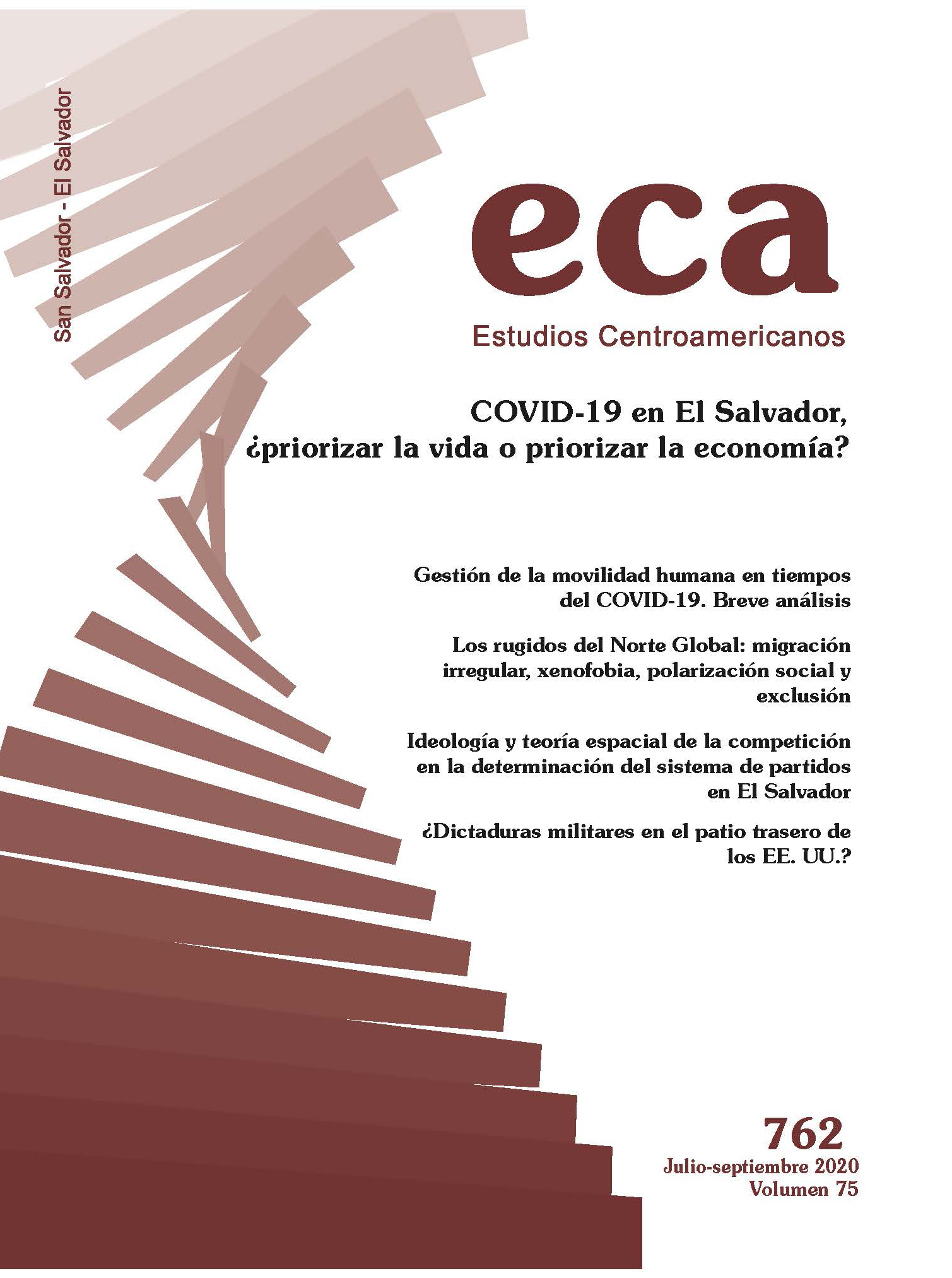
Ideology and spatial theory of the competition in the system determination matches in El Salvador
DOI:
https://doi.org/10.51378/eca.v75i762.3277Keywords:
Ideología, Similitud ideológica, Superposición ideológica, Distancia ideológica, Clustering, Partidos políticos, Continuum izquierda-derecha, Coherencia ideológica, Polarización ideológica, Partidos antisistema, Terceros incluidos e incluyentes, Pareo simple, Categorización directa, Análisis espacialAbstract
Ideological positioning on the left-right continuum is used to calculate unidimensional indicators of polarization, coherence, overlap, and ideological similarity, which enable an analysis of the electoral competitiveness of Salvadoran parties and their political strength. For these calculations, the formulas developed by Sani and Sartori are used, supplemented by similarity calculations based on Eisen’s cosine formula and the simple pairing formula. To determine and analyze the transition of El Salvador’s party system structure from a model of moderate pluralism to a polarized one, Sartori’s concepts of competitive systems and Bobbio’s analysis of the left-right dyad are used. The structure is determined using Ward’s clustering method. Finally, the results are applied to the spatial analysis of the electoral competition among Salvadoran political parties.
0
References
Alcántara, M. (Dir.). (1994-2018). Proyecto Élites Latinoamericanas (PELA-USAL). Universidad de Salamanca. https://oir.org.es/pela/bases-datos-paises/el-salvador/
Artiga-González, A. (2019). Elecciones 2019: la presidencia, el sistema de partidos y la forma de gobierno. Estudios Centroamericanos (ECA), 74(756), 13-35.
Artiga-González, A. (2007). Polarización política: orígenes, consecuencias y alternativas. En FUNDAUNGO, La polarización política
en El Salvador (pp. 1-22). FUNDAUNGO y FLACSO-Programa El Salvador.
Bobbio, N. (1996). Derecha e izquierda: razones y significados de una distinción política (8.a ed.). Santillana.
Eisen, M. B., Spellman, P. T., Brown, P. O. & Botstein, D. (1998). Cluster analysis and display of genome-wide expression patterns. Proceedings of the National Academy of Sciences of the United States of America, 95(25), 14863-14868. https://www.ncbi.nlm.nih.gov/pmc/articles/PMC24541/
Enelow, J. & Hinich, M. (1982). Ideology, Issues, and the Spatial Theory of Elections. The American Political Science Review, 76(3), 493-501. https://doi.org/10.1017/S0003055400188367
Everitt, B., Landau, S., Leese, M. & Stahl, D. (2011). Cluster Analysis. John Wiley & Sons.
Gan, G., Ma, C. & Wu, J. (2007). Data Clustering: Theory, algorithms and Applications. American Statistical Association and SIAM.
IUDOP. (2019). La población salvadoreña evalúa la situación general del país a finales del año 2019. Boletín de Prensa, XXXIV(1). http://www.uca.edu.sv/iudop/wp-content/uploads/BOLEVAL2019.pdf
Kaufman, L. & Rousseeuw, P. (2005). Finding Groups in Data: An Introduction to Cluster Analysis. John Wiley & Sons.
Latinobarómetro. (1995). Análisis de datos. https://www.latinobarometro.org/latOnline.jsp
Lipset, S. M. (1993). El hombre político: las bases sociales de la política. Red Editorial Iberoamericana México.
Marroquín, W. (4 de febrero de 2020). ¿Ha llegado el fin del FMLN y de Arena? Noticias UCA. https://noticias.uca.edu.sv/articulos/ha-llegado-el-fin-del-fmln-y-de-arena
Ruiz, L. M. y Otero, P. (2013). Indicadores de partidos y sistemas de partidos (vol. 51). Centro de Investigaciones Sociológicas (CIS).
Sani, G. y Sartori, G. (1980). Polarización, fragmentación y competición en las democracias occidentales. Revista de Derecho Político, 7, 7-37. https://doi.org/10.5944/rdp.7.1980.8032
Sartori, G. (2005). Partidos y sistemas de partidos. Marco para un análisis (2.a ed.). Alianza Editorial. Sartori, G. (1992). Elementos de teoría política. Alianza Editorial.
Wessa, P. (2017). Hierarchical Clustering - Free Statistics Software (Calculator). Free Statistics and Forecasting Software. https://www.wessa.net/rwasp_hierarchicalclustering.wasp
Zubin, J. (1938). A technique for measuring likemindedness. Journal of Abnormal Psychology, 33(4), 508-516. https://doi.org/10.1037/h0055441
Downloads
Published
How to Cite
Issue
Section
License

This work is licensed under a Creative Commons Attribution-NonCommercial-NoDerivatives 4.0 International License.
© ECA. Estudios Centroamericanos está bajo una licencia Creative Commons NonCommercial-NoDerivatives 4.0 International (CC BY-NC-ND 4.0).

La licencia no comercial y sin obra derivada permite la reproducción, distribución y comunicación pública, pero no la posibilidad de comercializar su contenido ni tampoco generar una obra derivada, como una traducción o adaptación, excepto que se pida permiso a los editores de dicha obra.
En ese sentido, se está en la libertad de:
Compartir: copiar y redistribuir el material en cualquier medio o formato.
Bajo las siguientes condiciones:
- Reconocimiento: se debe dar crédito a esta obra de manera adecuada, proporcionando un enlace a la licencia, e indicando si se han realizado cambios.
- Uso no comercial: no se puede hacer uso del material con fines comerciales.
- Sin obra derivada: si se remezcla, transforma o construye sobre ese material, no se puede distribuir el material modificado.

