
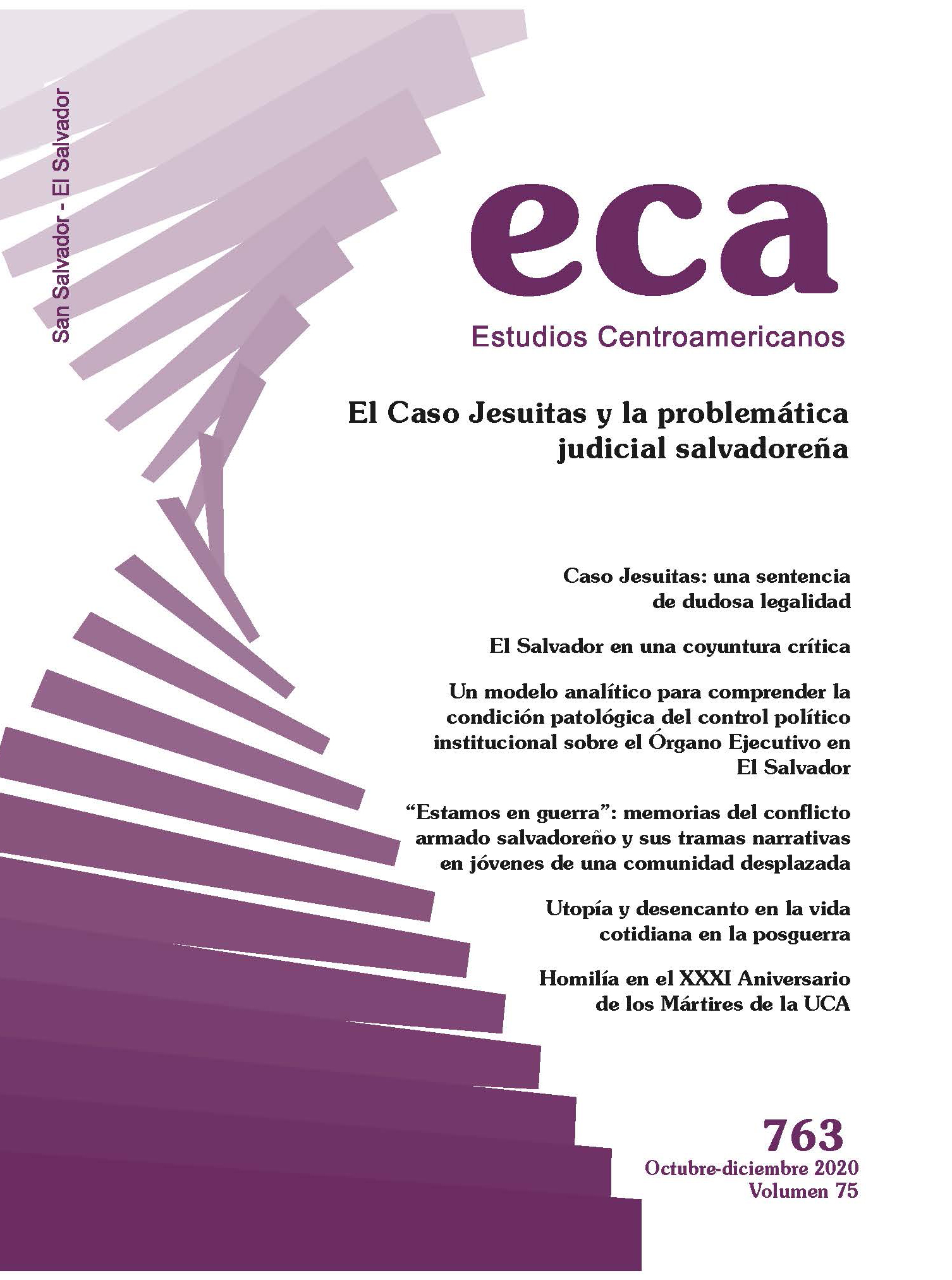
El Salvador in a critical juncture
DOI:
https://doi.org/10.51378/eca.v75i763.3282Keywords:
Authoritarianism, El Salvador, Elections, Politics, Party system, DemocracyAbstract
At the end of the second decade of the 21st century, El Salvador is at a critical juncture in its process of social transformation. Amid changes in the economy, demographics, and the cultural-religious sphere, it appears that the authoritarian tendencies currently prevalent in the regime will ultimately prevail in Salvadoran politics. The current president of the Republic has encountered difficulties in implementing his political agenda due to institutional constraints stemming from the lack of a party of his own or a legislative caucus supporting him, a context of divided government, and a system that renders the presidency institutionally weak. Under these conditions, the president and his administration have sought to overcome these difficulties through authoritarian means. At the same time, a shift in the Salvadoran party system is underway. The outcome of this shift may shed light on the direction of change in the political regime. A change brought about by collapse will favor the transition toward an authoritarian regime. A gradual change may favor either the maintenance of the status quo or the re-accumulation of forces to democratize the regime. But the latter path requires the emergence of forces for democratization in spheres beyond politics and the implementation of welfare policies.
18
References
Artiga-González, Á. (2019). Elecciones 2019: la presidencia, el sistema de partidos y la forma de gobierno. Estudios Centroamericanos (ECA), 74(756), 13-36.
Artiga-González, Á. (2015). El sistema político salvadoreño. Programa de las Naciones Unidas para el Desarrollo (PNUD).
Comisión Económica para América Latina y el Caribe (CEPAL). (1993). La economía salvadoreña en el proceso de consolidación de la paz. https://repositorio.cepal.org/bitstream/handle/11362/27053/LCMEXR414REV1_es.pdf?sequence=1
Chasquetti, D. (2001). Democracia, multipartidismo y coaliciones en América Latina: evaluando la difícil combinación, en Lanzaro, J. (Comp.), Tipos de presidencialismo y coaliciones políticas en América Latina (pp. 319-359). Consejo Latinoamericano de Ciencias Sociales (CLACSO).
Escamilla Cadena, A. y Sánchez Gayosso, R. (2016). Las facultades constitucionales del Ejecutivo en América Latina: entre la concentración y la dispersión del poder. Estudios Políticos, 9(37), 111-141. http://www.redalyc.org/articulo.oa?id=426443710005
Freindenberg, F. (2016). Los sistemas de partidos en América Latina 1978-2015 (2 tomos). Universidad Nacional Autónoma de México e Instituto Nacional Electoral.
Instituto Universitario de Opinión Pública (IUDOP). (2019a). Encuesta de opinión sobre el desplazamiento interno forzado por violencia y las medidas extraordinarias. Serie de Informes, 147.
IUDOP. (2019b). Base de datos poselectoral 2019.
IUDOP. (2018). Encuesta de evaluación del cuarto año de Gobierno de Salvador Sánchez
Cerén, Asamblea Legislativa, Corte Suprema de Justicia y evaluación poselectoral. Serie de Informes, 145.
IUDOP. (2013). Encuesta de evaluación del año 2013 y sobre las elecciones presidenciales de 2014. Serie de Informes, 133.
IUDOP. (2008). Encuesta de evaluación del año 2008 y sobre el proceso electoral 2009. Serie de Informes, 118.
IUDOP. (2003). Encuesta de evaluación del año 2003. Serie de Informes, 102.
IUDOP. (1998). Encuesta de evaluación del año 1998. Serie de Informes, 72.
IUDOP. (1995). Encuesta sobre la religión de los salvadoreños y los retos del nuevo arzobispo. Serie de Informes, 49.
IUDOP. (1993). Evaluación de la gestión gubernamental en el presente año. Serie de Informes, 38.
Laakso, M. y Taagepera, R. (1979). Effective Number of Parties. A Measure with Application to West Europe. Comparative Political Studies, 12(1), 3-27. https://www.researchgate.net/publication/241645380_The_Effective_number_of_parties_a_measure_with_application_to_West_Europe
Mainwaring, S. (1993). Presidentialism and Multipartism. The Difficult Combination. Comparative Political Studies, 26(2), 198-228. https://www.researchgate.net/publication/258130109_Presidentialism_Multipartism_and_Democracy_The_Difficult_Combination
Martínez, Ó. y Martínez, J. J. (2019). El niño de Hollywood. Penguin Random House.
Montes, S. (1980). El agro salvadoreño 1973-1980. Publicaciones del Departamento de Sociología y Ciencias Políticas, Universidad Centroamericana “José Simeón Cañas”.
Rae, D. (1967). The Political Consequences of Electoral Laws. Yale University Press.
Sánchez de Dios, M. (2018). El cambio de los sistemas de partidos en el siglo XXI. Apuntes Electorales, XVII (58), 97-132. https://dialnet.unirioja.es/ejemplar/488373
Sartori, G. (1992). Partidos y sistemas de partidos. Alianza Editorial.
Schedl e r, A. (2006). Electoral Authoritarianism: The Dynamics of Unfree Competition. Lynne Rienner Publishers.
Schedler, A. (2004). Elecciones sin democracia. El menú de la manipulación electoral. Estudios Políticos, 24, 137-156. https://revistas.udea.edu.co/index.php/estudiospoliticos/article/view/1367/1469
Schumpeter, J. A. (1968). Capitalismo, socialismo y democracia. Aguilar.
Szmolka Vida, I. (2010). Los regímenes políticos híbridos: democracias y autoritarismos con adjetivos. Su conceptualización, categorización y operación dentro de la tipología de regímenes políticos, Revista de Estudios Políticos (nueva época), 147, 103-135. https://recyt.fecyt.es/index.php/RevEsPol/article/view/44340
Downloads
Published
How to Cite
Issue
Section
License

This work is licensed under a Creative Commons Attribution-NonCommercial-NoDerivatives 4.0 International License.
© ECA. Estudios Centroamericanos está bajo una licencia Creative Commons NonCommercial-NoDerivatives 4.0 International (CC BY-NC-ND 4.0).

La licencia no comercial y sin obra derivada permite la reproducción, distribución y comunicación pública, pero no la posibilidad de comercializar su contenido ni tampoco generar una obra derivada, como una traducción o adaptación, excepto que se pida permiso a los editores de dicha obra.
En ese sentido, se está en la libertad de:
Compartir: copiar y redistribuir el material en cualquier medio o formato.
Bajo las siguientes condiciones:
- Reconocimiento: se debe dar crédito a esta obra de manera adecuada, proporcionando un enlace a la licencia, e indicando si se han realizado cambios.
- Uso no comercial: no se puede hacer uso del material con fines comerciales.
- Sin obra derivada: si se remezcla, transforma o construye sobre ese material, no se puede distribuir el material modificado.

