
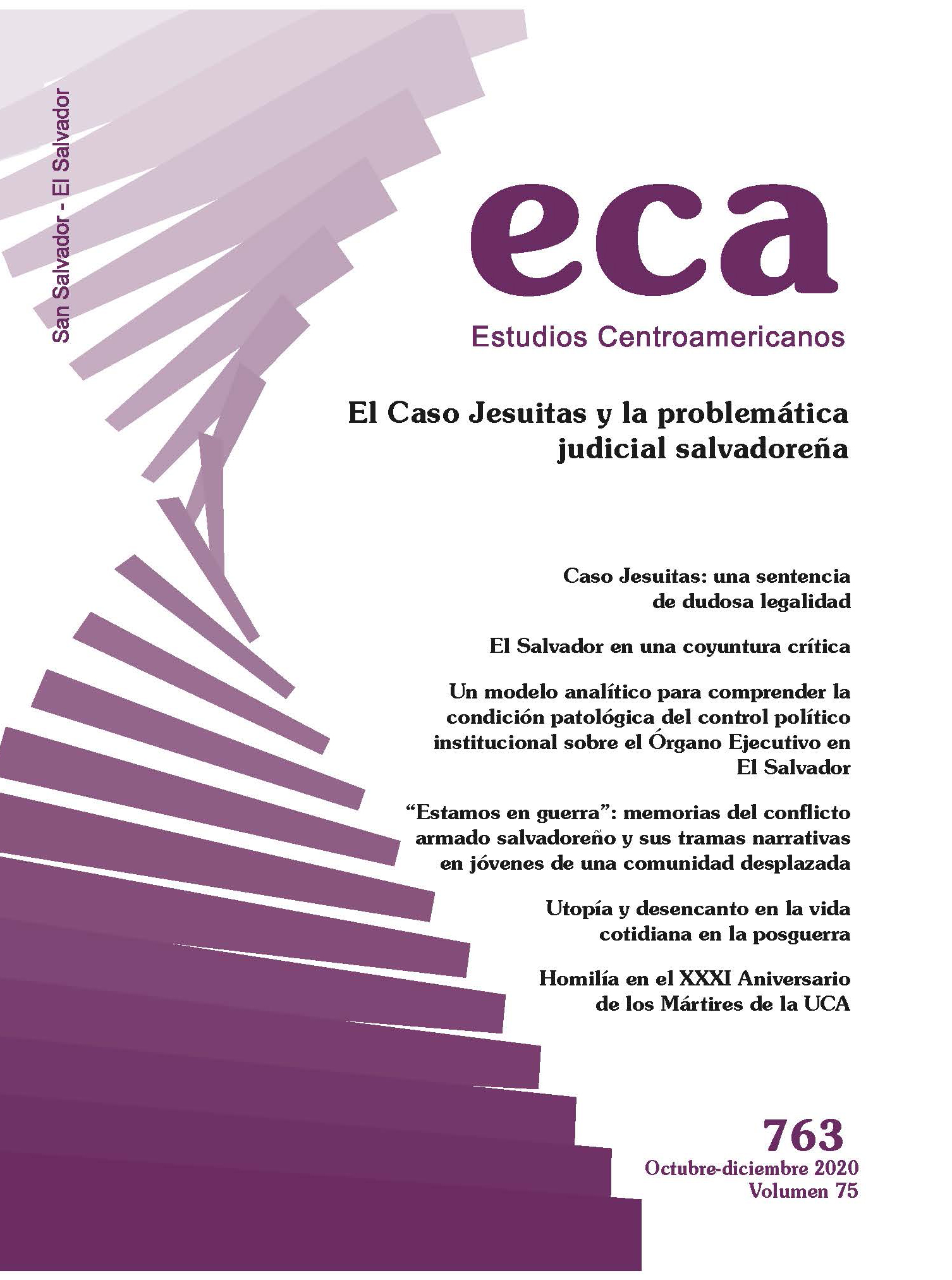
Jesuits Case: one doubtful sentence legality
DOI:
https://doi.org/10.51378/eca.v75i763.3281Keywords:
The Jesuit Case, National Court, Criminal Court, Amnesty ActAbstract
In the Jesuit Case trial in El Salvador, on Thursday, October 29, 2020, the Salvadoran justice system once again sided with the alleged war criminals. In this case, it was the Criminal Chamber of the Supreme Court of Justice, through its ruling issued at 8:30 a.m. on September 8, 2020, signed by presiding judge José Roberto Argueta Manzano and alternate judge Juan Manuel Bolaños Sandoval.2 A few weeks after learning of the Spanish National Court’s ruling against former Colonel Inocente Montano, convicted in Spain as one of the masterminds behind the Jesuit case,3 the Salvadoran justice system, through the Criminal Chamber, decided that the other alleged masterminds of the UCA Massacre should not be investigated in El Salvador, despite the ruling declaring the Amnesty Law unconstitutional.
19
Downloads
Published
How to Cite
Issue
Section
License

This work is licensed under a Creative Commons Attribution-NonCommercial-NoDerivatives 4.0 International License.
© ECA. Estudios Centroamericanos está bajo una licencia Creative Commons NonCommercial-NoDerivatives 4.0 International (CC BY-NC-ND 4.0).

La licencia no comercial y sin obra derivada permite la reproducción, distribución y comunicación pública, pero no la posibilidad de comercializar su contenido ni tampoco generar una obra derivada, como una traducción o adaptación, excepto que se pida permiso a los editores de dicha obra.
En ese sentido, se está en la libertad de:
Compartir: copiar y redistribuir el material en cualquier medio o formato.
Bajo las siguientes condiciones:
- Reconocimiento: se debe dar crédito a esta obra de manera adecuada, proporcionando un enlace a la licencia, e indicando si se han realizado cambios.
- Uso no comercial: no se puede hacer uso del material con fines comerciales.
- Sin obra derivada: si se remezcla, transforma o construye sobre ese material, no se puede distribuir el material modificado.

