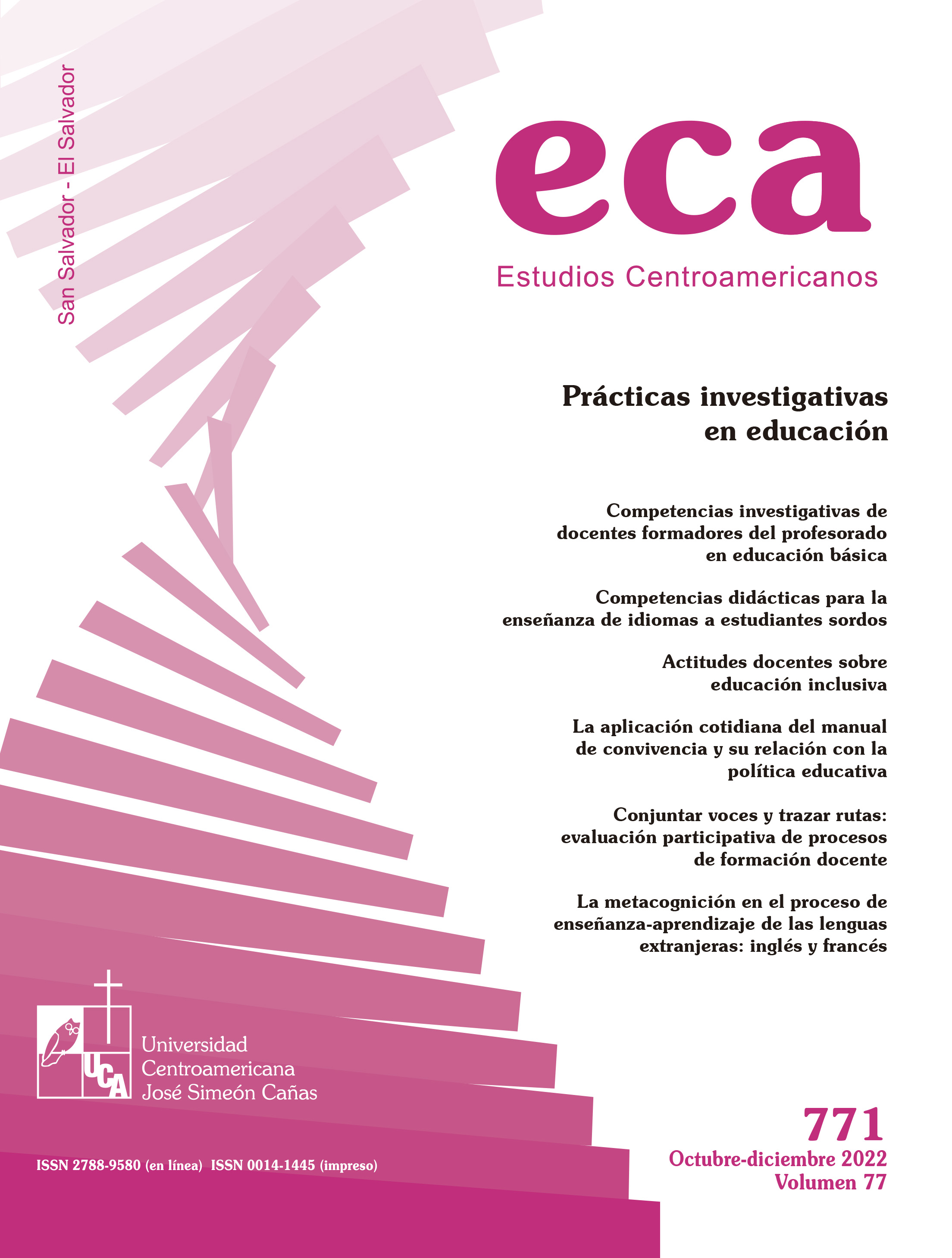
The The aily application of the manual of coexistence and its relation to educational policy
DOI:
https://doi.org/10.51378/eca.v77i771.7742Keywords:
Manual of coexistence, Educational policy, Culture of peace, Punitive approach, Formative approachAbstract
Abstract In El Salvador, the manual of coexistence was introduced in 2007 as part of an international initiative to promote educa- tion from the human rights approach. In 2018, 92.66% of public schools already had a MC (MINED, 2018, p. 14), which, according to MINED, should be applied as a resource to build a culture of peace. Its function is key in guiding schools in conflict prevention and resolution through formative strategies. However, scholarship in the field of educational policy reveal how schools in their daily lives uses the MC from a punitive approach that is not linked to the peace approach promoted by the Ministry of Education. However, in the 13 years of existence, little is known about the application of MC in the daily life of schools. Given this, this research seeks to understand the disconnection between the peace approach of the promoted by the education policy and the daily application of MC in public schools. On the one hand, the education policy establishes that the MC should be formative, promote values and creative responses to conflicts; on the other hand, schools implement the MC from a punitive approach. Although the education policy requires schools to develop a MC with a formative approach, there are no concrete guidelines on how these formative strategies can be developed from the immediate context of each institution. As a result, schools build their protocols based on what has worked for them before, with the goal of protecting the institutional image and the work of teachers. This research presents qualitative evidence on the implementation of MC, linking the day-to-day experiences of public schools with education policy. The results show that the pressures generated by different social groups have led schools to develop their own rules on applying MC, aimed at maintaining control of behaviour within the institution and coping with these pressures.
ECA Estudios Centroamericanos, Vol. 77, No. 771, 2022: 67-80.
11
Downloads
Published
How to Cite
Issue
Section
License
Copyright (c) 2022 ECA. Estudios Centroamericanos

This work is licensed under a Creative Commons Attribution-NonCommercial-NoDerivatives 4.0 International License.
© ECA. Estudios Centroamericanos está bajo una licencia Creative Commons NonCommercial-NoDerivatives 4.0 International (CC BY-NC-ND 4.0).

La licencia no comercial y sin obra derivada permite la reproducción, distribución y comunicación pública, pero no la posibilidad de comercializar su contenido ni tampoco generar una obra derivada, como una traducción o adaptación, excepto que se pida permiso a los editores de dicha obra.
En ese sentido, se está en la libertad de:
Compartir: copiar y redistribuir el material en cualquier medio o formato.
Bajo las siguientes condiciones:
- Reconocimiento: se debe dar crédito a esta obra de manera adecuada, proporcionando un enlace a la licencia, e indicando si se han realizado cambios.
- Uso no comercial: no se puede hacer uso del material con fines comerciales.
- Sin obra derivada: si se remezcla, transforma o construye sobre ese material, no se puede distribuir el material modificado.

