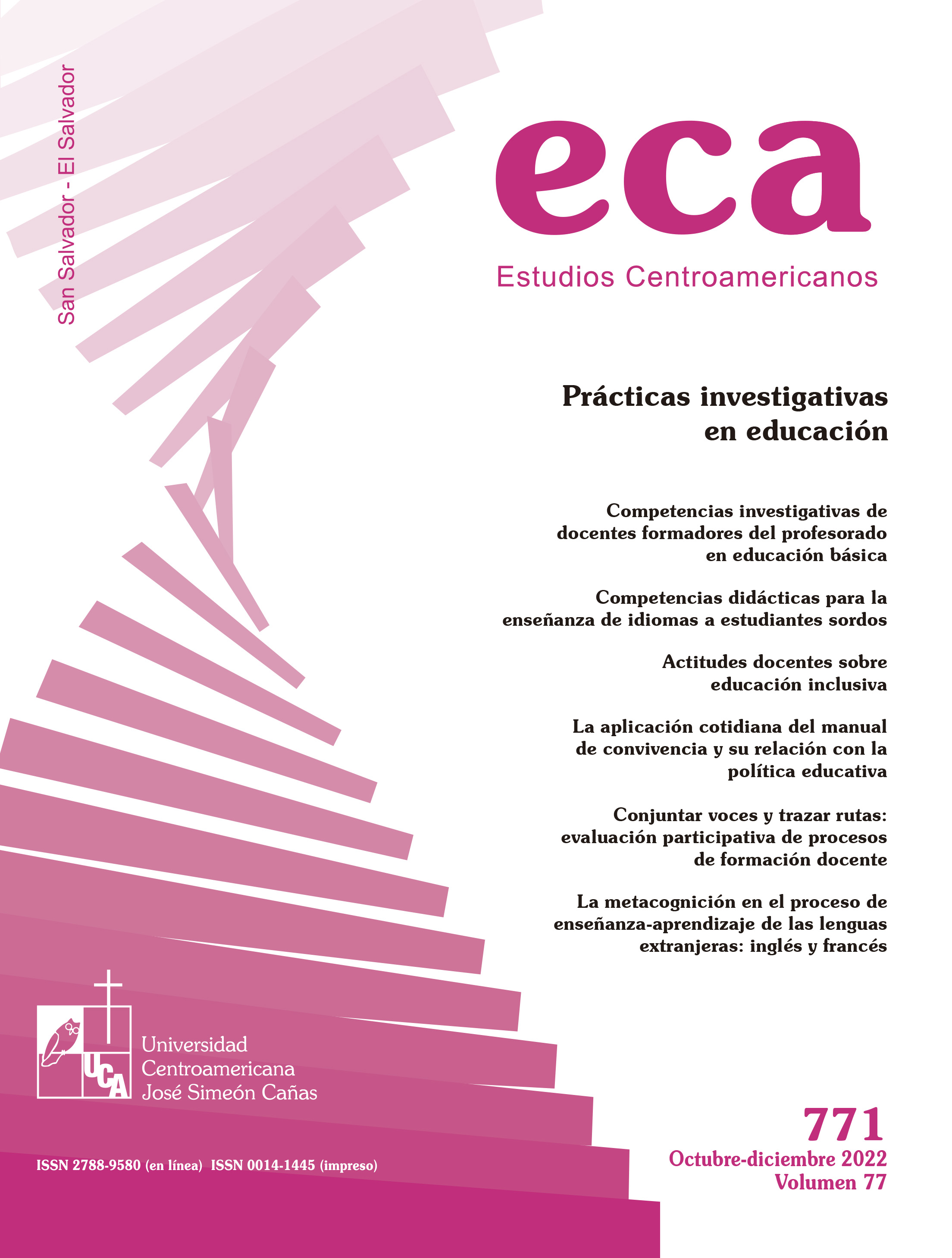
Metacognition in foreign languages (English and French) teaching-learning process
DOI:
https://doi.org/10.51378/eca.v77i771.7744Keywords:
Metacognition, Autoregulation, Foreign language teaching, Linguistic competitionsAbstract
The way towards a practical way of propi- tiating innovation in the English and French as foreign language courses through the appli- cation of metacognitive strategies. However, metacognition represents for many teachers an unknown area. This article contains the results obtained from an investigation carried out with 37 English and French teachers as foreign languages belonging to a private university of El Salvador. Three aspects were specifically explored: (1) how acquainted English and French as foreign language teachers are with metacognitive strategies; (2) from the teacher perspective, how the metacognition could help students in the learning process of a foreign language; and (3) from language teachers point of view, which activities allow the effective integration of metacognition in the learning process of a foreign language like English and French so that students achieve autoregulation. The results reveal that although most of the teachers have listened the term metacognition before, they do not have a clear idea of what it is and what is involved in its application in the courses of foreign languages. Yet they consider that integrating metacognition techniques in the teaching-learning languages process is relevant and recognize that to be trained in this area could help the students in their learning of English and French languages.
ECA Estudios Centroamericanos, Vol. 77, No. 771, 2022: 105-122.
7
Downloads
Published
How to Cite
Issue
Section
License
Copyright (c) 2022 ECA. Estudios Centroamericanos

This work is licensed under a Creative Commons Attribution-NonCommercial-NoDerivatives 4.0 International License.
© ECA. Estudios Centroamericanos está bajo una licencia Creative Commons NonCommercial-NoDerivatives 4.0 International (CC BY-NC-ND 4.0).

La licencia no comercial y sin obra derivada permite la reproducción, distribución y comunicación pública, pero no la posibilidad de comercializar su contenido ni tampoco generar una obra derivada, como una traducción o adaptación, excepto que se pida permiso a los editores de dicha obra.
En ese sentido, se está en la libertad de:
Compartir: copiar y redistribuir el material en cualquier medio o formato.
Bajo las siguientes condiciones:
- Reconocimiento: se debe dar crédito a esta obra de manera adecuada, proporcionando un enlace a la licencia, e indicando si se han realizado cambios.
- Uso no comercial: no se puede hacer uso del material con fines comerciales.
- Sin obra derivada: si se remezcla, transforma o construye sobre ese material, no se puede distribuir el material modificado.

