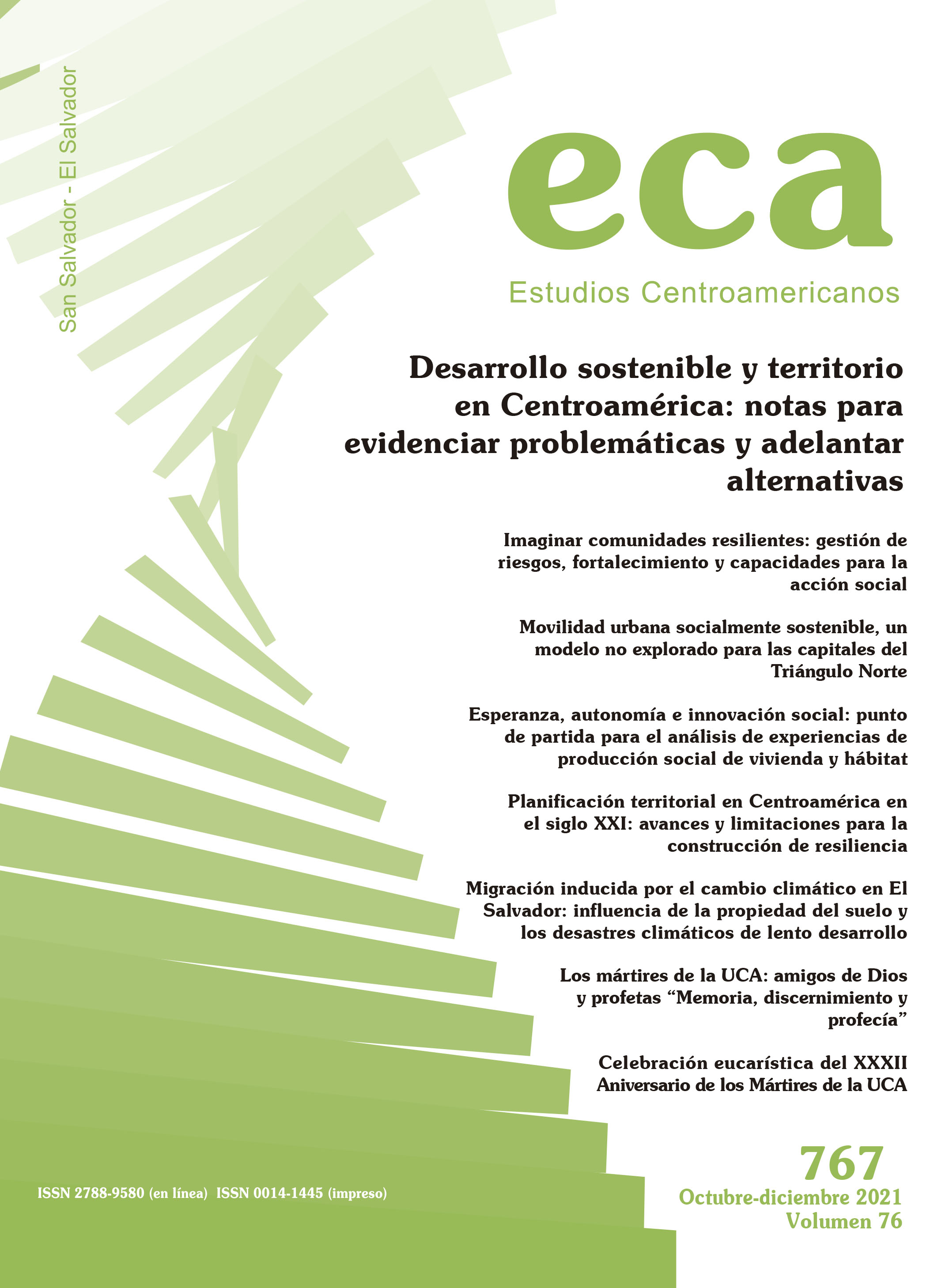
Territorial planning in Central America in the 21st century: advances and limitations for building resilience
DOI:
https://doi.org/10.51378/eca.v76i767.6474Keywords:
Central America, Regional planning, Resilience, Sustainable development, Risk managementAbstract
During the first two decades of the 21st century, Central American countries have made significant efforts in territorial planning, including the development of instruments at the national, subnational, metropolitan, and local levels. In addition, as part of the regional integration process, policies, strategies, and agendas have been prepared on issues such as land use planning, housing, roads, rural development, and risk management. All of this has been driven in part by international agreements that promote sustainable development, comprehensive risk management, and resilience building. This paper explores how territorial planning in the region has limited or contributed to promoting resilience by studying five emblematic planning experiences in Guatemala, Honduras, El Salvador, and Costa Rica. To this end, it starts from a theoretical framework based on Bourdieu's structural constructivism, which allows territorial planning to be understood as a field of social life with agents, relationships, rules, and resources. In addition, it reviews various perspectives on the concept of resilience and its link to sustainability and vulnerability. The study applies a pluralistic and qualitative methodological strategy based on a case study using document review techniques and interviews with key informants. Despite the stated commitments to sustainable development, four tensions emerge from the study that explain the main limitations of planning to build resilience in Central America: the lack of coordination between economic development strategies; the fragility of planning systems; the difficulties of managing metropolitan areas; and the limited participation of stakeholders. Two principles seem to explain this dynamic: disputes over control of the territory and struggles for the exercise of political power in the space. All of this invites deeper reflection on the relationships between actors, the weight of international agendas, and ultimately the conflictive nature of territorial planning.
25
Downloads
Published
How to Cite
Issue
Section
License
Copyright (c) 2021 ECA: Estudios Centroamericanos

This work is licensed under a Creative Commons Attribution-NonCommercial-NoDerivatives 4.0 International License.
© ECA. Estudios Centroamericanos está bajo una licencia Creative Commons NonCommercial-NoDerivatives 4.0 International (CC BY-NC-ND 4.0).

La licencia no comercial y sin obra derivada permite la reproducción, distribución y comunicación pública, pero no la posibilidad de comercializar su contenido ni tampoco generar una obra derivada, como una traducción o adaptación, excepto que se pida permiso a los editores de dicha obra.
En ese sentido, se está en la libertad de:
Compartir: copiar y redistribuir el material en cualquier medio o formato.
Bajo las siguientes condiciones:
- Reconocimiento: se debe dar crédito a esta obra de manera adecuada, proporcionando un enlace a la licencia, e indicando si se han realizado cambios.
- Uso no comercial: no se puede hacer uso del material con fines comerciales.
- Sin obra derivada: si se remezcla, transforma o construye sobre ese material, no se puede distribuir el material modificado.

