
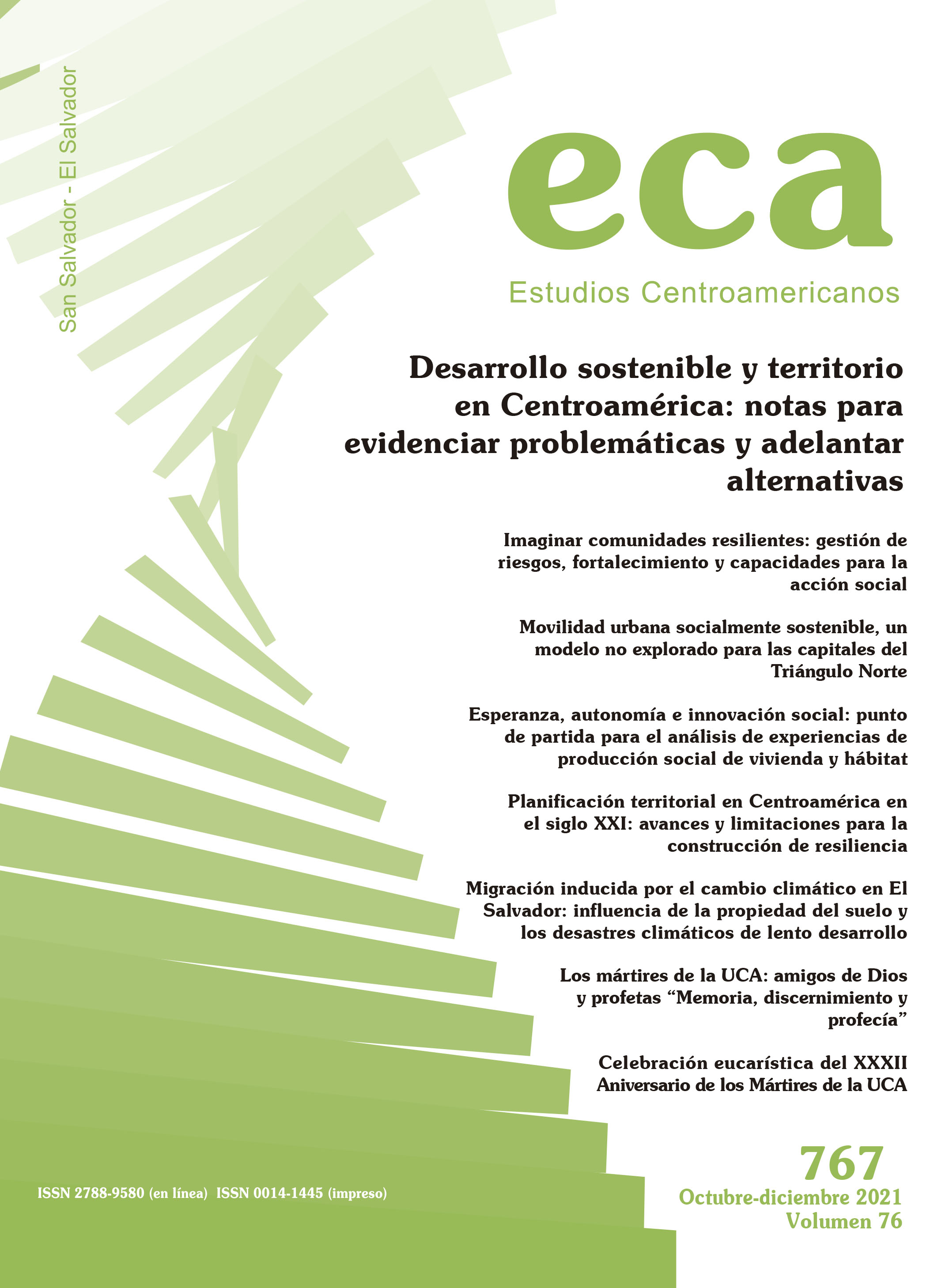
Hope, autonomy and social innovation: starting point for the analysis of experiences of social production of housing and habitat
DOI:
https://doi.org/10.51378/eca.v76i767.6473Keywords:
Hope, Autonomy, Social innovation, Social production, Housing, HabitatAbstract
The objective of this article is to present a theoretical exploration that serves as a starting point for the construction of a model for the comparative analysis of alternative experiences of housing and habitat production in Latin America. It begins with a general contextualization that highlights some of the main problems of the housing sector within contemporary urban processes, emphasizing the emergence of alternative experiences of organized self-production and the need to bring the accumulated empirical tradition into dialogue with urban theories and other currents of thought. It then goes on to articulate the concepts of Social Production of Housing and Habitat (SPHH), Social Innovation (SI), Hope, and Autonomy, through the exploration of theoretical contributions from different fields (sociology, geography, philosophy, urban studies, etc.), concluding with the following ideas: 1/ The concept of PSVH, as opposed to the neoliberal view of housing as a market commodity, is very useful for categorizing experiences of organized self-production of housing that respond to counter-hegemonic principles and are based on a human rights perspective; 2/ It is possible to refer to Social Innovation in Housing (IS-H), that is, to frame PSVH experiences within broader social processes of Social Innovation, insofar as they are driven by organized practices rooted in the territory, are committed to territorial development processes, and when land (its access and management) is identified as a product and objective of the IS-H's vindicative and creative process; 3/ Hope acts as the driving and guiding force behind SI-H processes when it originates from repetitive processes of knowledge co-production (from the social base) capable of triggering space-time prefiguration processes rooted in the territorial resources of the present and materialized in everyday practices aimed at anticipating a future that ‘is not yet’; and 4/ IS-H experiences embark on a project of Autonomy when they form part of a political project of organizing hope committed to the materialization of an alternative and counter-hegemonic life project, based on self-determination and the will to break with structural conditions of oppression and inequality.
48
Downloads
Published
How to Cite
Issue
Section
License
Copyright (c) 2021 ECA: Estudios Centroamericanos

This work is licensed under a Creative Commons Attribution-NonCommercial-NoDerivatives 4.0 International License.
© ECA. Estudios Centroamericanos está bajo una licencia Creative Commons NonCommercial-NoDerivatives 4.0 International (CC BY-NC-ND 4.0).

La licencia no comercial y sin obra derivada permite la reproducción, distribución y comunicación pública, pero no la posibilidad de comercializar su contenido ni tampoco generar una obra derivada, como una traducción o adaptación, excepto que se pida permiso a los editores de dicha obra.
En ese sentido, se está en la libertad de:
Compartir: copiar y redistribuir el material en cualquier medio o formato.
Bajo las siguientes condiciones:
- Reconocimiento: se debe dar crédito a esta obra de manera adecuada, proporcionando un enlace a la licencia, e indicando si se han realizado cambios.
- Uso no comercial: no se puede hacer uso del material con fines comerciales.
- Sin obra derivada: si se remezcla, transforma o construye sobre ese material, no se puede distribuir el material modificado.

