
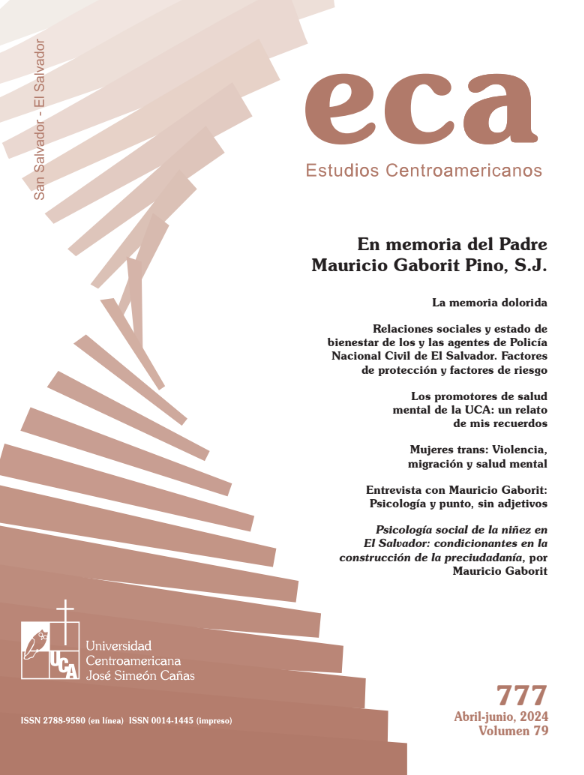
Relaciones sociales y estado de bienestar de los y las agentes de Policía Nacional Civil de El Salvador. Factores de protección y factores de riesgo
Palabras clave:
Factores de protección, Factores de Riesgo, Estado de Bienestar, Relaciones Sociales, Relaciones familiares, Relaciones laborales, Relaciones con los y las ciudadanasResumen
En toda sociedad los cuerpos policiales juegan un papel clave en el mantenimiento de la paz y la seguridad. En el caso de El Salvador, la Policía Nacional Civil es la principal instancia del Estado que tiene a su cargo el servir y proteger a la población salvadoreña, manteniendo el orden y la seguridad desde un enfoque de derechos humanos. Esta tarea se vuelve más compleja en un país en donde la tasa de homicidios ha alcanzado altos niveles en las últimas décadas. En 2015 se le clasificó como uno de los países más violentos a nivel mundial, por cuanto alcanzó una tasa de 103 víctimas de hechos de violencia por cada 100,000 habitantes. Ante la violencia que ha aquejado el país, los diferentes gobiernos han impulsado diversas políticas de seguridad de las cuales es precisamente la PNC la instancia encargada de llevarlas a cabo.
En este artículo se pretende ver más allá de la Policía Nacional Civil como una corporación estatal encargada de la seguridad, pues se busca enfatizar en las personas que son parte de ella, principalmente los y las agentes de policía. Es así que se buscó indagar sobre los diversos factores de protección y factores riesgo que afectan el estado de bienestar de los y las agentes, dentro de las diferentes relaciones sociales en las que se desenvuelven, siendo estas las relaciones familiares, las relaciones laborales y las relaciones con la ciudadanía. Lo anterior tiene lugardentro de un contexto social impregnado por la violencia y en donde se les ha conferido protagonismo en hacer frente a esta problemática.
101
Descargas
Publicado
Cómo citar
Número
Sección
Licencia

Esta obra está bajo una licencia internacional Creative Commons Atribución-NoComercial-SinDerivadas 4.0.
© ECA. Estudios Centroamericanos está bajo una licencia Creative Commons NonCommercial-NoDerivatives 4.0 International (CC BY-NC-ND 4.0).

La licencia no comercial y sin obra derivada permite la reproducción, distribución y comunicación pública, pero no la posibilidad de comercializar su contenido ni tampoco generar una obra derivada, como una traducción o adaptación, excepto que se pida permiso a los editores de dicha obra.
En ese sentido, se está en la libertad de:
Compartir: copiar y redistribuir el material en cualquier medio o formato.
Bajo las siguientes condiciones:
- Reconocimiento: se debe dar crédito a esta obra de manera adecuada, proporcionando un enlace a la licencia, e indicando si se han realizado cambios.
- Uso no comercial: no se puede hacer uso del material con fines comerciales.
- Sin obra derivada: si se remezcla, transforma o construye sobre ese material, no se puede distribuir el material modificado.