
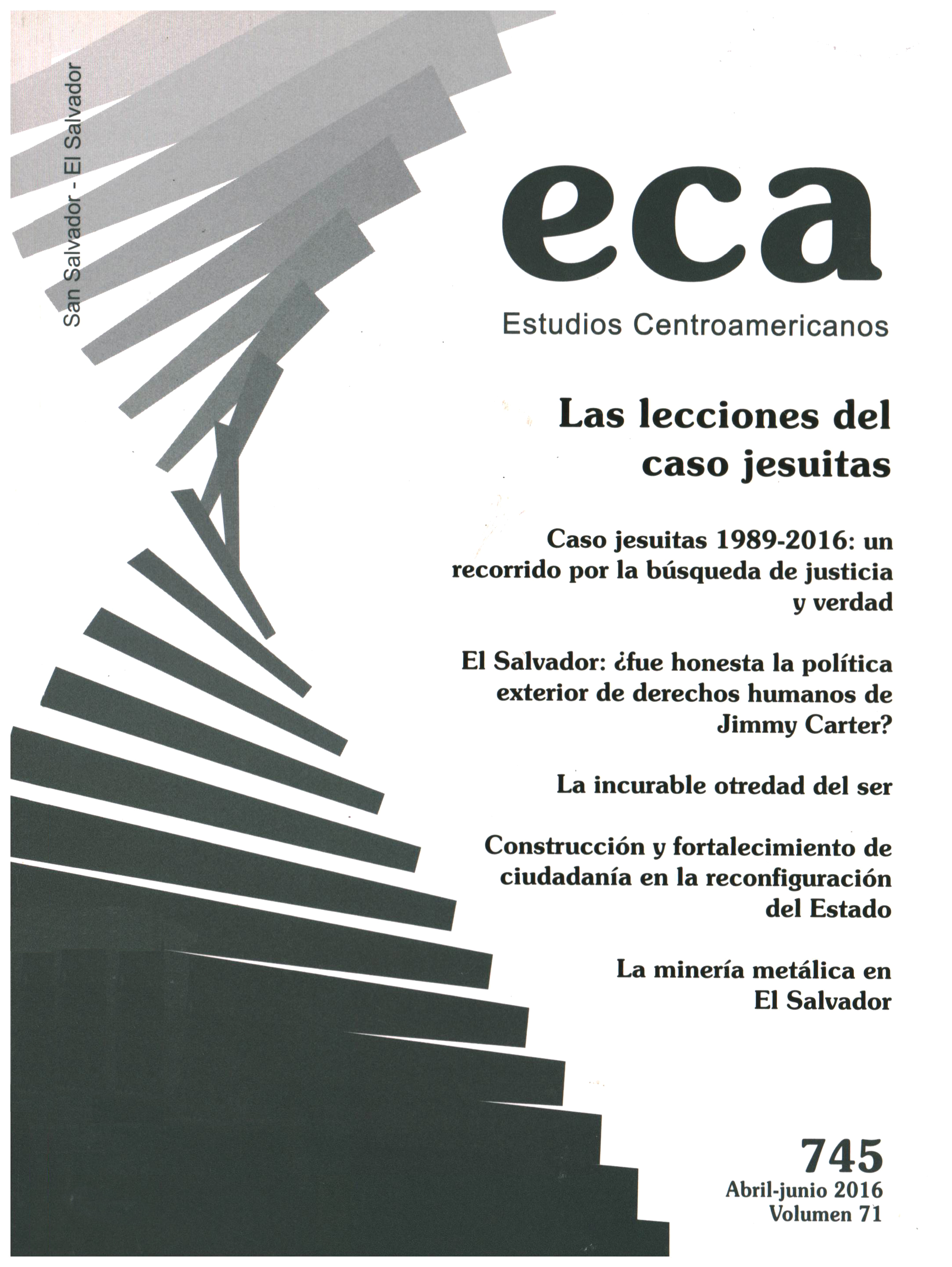
El Salvador: ¿fue honesta la política exterior de derechos humanos de Jimmy Carter?
DOI:
https://doi.org/10.51378/eca.v71i745.3179Palabras clave:
Política exterior, Derechos humanos, Liberalismo, Realismo, Teoría del dominó, Doctrina Monroe, Relaciones internacionalesResumen
En este artículo se demostrará que el supuesto énfasis en el respeto a los derechos humanos de la política exterior del expresidente estadounidense Jimmy Carter fue de naturaleza demagógica. En sus relaciones internacionales, su retórica fue de carácter liberal, pero su accionar fue determinado por el realismo. Su política exterior de derechos humanos fue una medida cosmética que persiguió el mantenimiento de la hegemonía estadounidense sobre los países bajo su dominio, al tiempo que la presentaba como respetuosa de la soberanía de los sometidos. Acá se dará particular atención al caso de El Salvador.
1
Citas
Adam, E. P. (1979). "Chronology 1979". Foreign Affairs, vol. 58, n. ° 3, America and the World, pp. 738-774.
Adam, E. P. (1980). "Chronology 198". Foreign Affairs, vol. 59, n.° 3, America and the World, pp. 714-742.
Adam, E. P. (1981). "Chronology 1981". Foreign Affairs, vol. 60, n. ° 3, America and the World 1981, pp. 719-752.
Armstrong, D.; Farrel, T. and Lambert, H. (2007). International Law and International Relations. Cambridge: Cambridge University Press.
Barkin, S. (2010). Realist Constructivism: Rethinking International Relations Theory. Cambridge: Cambridge University Press.
Bickerton, I. and Pearson, M. (1991).43 Days: The Gulf War. Australia: ABC Books.
Brinkley, D. (1998). The unfinished presidency: Jimmy Carter's journey beyond the White House. New York: Penguin Putnam.
CIA, Directorate of Intelligence, Intelligence Report: The Committed Church and Change in Latin America, Referencia: ESAU XLIIIV/69, SECRET RSS n.° 0039/69.
Calvert, P (1994). The International Politics of Latin America. Manchester: Manchester University Press.
Carter, J. (1977). "Human Rights and Foreign Policy" (speech at the Notre Dame University, South Bond, USA.
Constable, P (2015). "Robert E. White, who criticized policy on El Salvador as U. S. ambassador, dies at 88". The Washington Post, January 15, 2015.
Crabb, C. V. Jr. (1982). The Doctrines of American Foreign Policy: The meaning, role, and future. Louisiana: Louisiana State University.
De La Calle, A. L. (1980). "Guerrilleros salvadoreños ocupan sede de la Democracia Cristiana". Periódico español El País. Recuperado en: http://elpais.com/diarioIl980/01/31/internacionaV318121219_850215.htrnl
Dunham, R. G. and Mauss, A. L. (1976). "Waves from Watergate: Evidence Concerning the Impact of the Watergate Scandal upon Political Legitimacy and Social Control". The Pacific Sociological Review, vol. 19, n. ° 4, pp. 469-490.
Forsythe, D. P (2006). Human Rights in International Relations. Cambridge: Cambridge University Press, (2 ° ed.).
Hargrove, E. C. (1988). Jimmy Carter as President: Leadership and the politics of the public good. Baton Rouge, LA: Lousiana State University Press.
Hartman, H. (2001). "US Human Rights Policy under Carter and Reagan, 1977-1981". Human Rights Quarterly, vol. 23. n. ° 2, pp. 402-430.
Herring, G. C. (2008). From Colony to Superpower: U.S. Foreign Relations Since 1776. New York: Oxford University Press.
Hitchins, C. (2001). The Trial of Henry Kissinger. London: Verso Press.
Hutcheson, R. G. Jr. (1988). God in the White House: How religion has changed the modern presidency. New York: Collier Books.
Lang, G. E. and Lang, K. (1980). "Polling on Watergate: The Battle for Public Opinion". The Public Opinion Quarterly, vol. 44, n. ° 4, pp. 530-547.
Ledeem, M. and Lewis, W. (1981). Debacle: The American Failure in Iran. New York: Knopf.
Lamperti, J. (2006). Enrique Álvarez Córdova: Life of a Salvadoran Revolutionary and Gentleman. North Carolina: McFarland & Company, Inc.
Lowenthal, A. F. (1983). "Change the Agenda". Foreign Policy, n. ° 52, pp. 64-67.
Mariani, J. M. (2011). Does It Still Matter? The Impact of the Vietnam Syndrome on American Foreign Policy? CUERJ, College of Art and Sciences, University of Pensylvania.
McCormick, J. M. (2004). 'The Foreign Policy of the George W. Bush administration", en High risk and big ambition: The Presidency
of George W Bush (2004) edited by S. E. Schier. Pittsburgh: University of Pittsburgh Press.
Modell, J. and Haggerty, T. (1991). "The Social Impact of War". Annual Review of Sociology, vol. 17, pp. 205-224.
Murphy, G. (2005). Hemispheric Imagings: the Monroe Doctrine and Narrative of U.S. Empire. Durham: Duke University Press.
Pakistan Institute of International Affairs (1979). "Chronology 1979". Pakistan Horizons, vol. 32, n. ° 4, Pakistan Foreign Policy (Fourth Quarter, 1979), pp. 147-197.
Pakistan Institute of International Affairs (1980). "Chronology June-August 1980". Pakistan Horizons, vol. 33, n. ° 3, pp. 106-171.
Pakistan Institute of International Affairs (1980). "Chronology December 1980". Pakistan Horizons, vol. 33, n. ° 4, pp. 88-132.
Pakistan Institute of International Affairs (1980-1981). "Chronology December 1980 February 1981". Pakistan Horizons, vol. 34, n. ° 1, The Inter-Relations of Muslim States and Pakistan, pp. 140-196.
Presidential Directive/NSC-2, The White House, Washington, January 20, 1977.Romero, R. (2014). "Escuela de las Américas o Escuela de Violadores de Derechos Humanos?". Estudios Centroamericanos (ECA), vol. 69, n. ° 739. San Salvador, El Salvador: ECA Editores.
Scovazzi, T. and Citroni, G. (2007). The Struggle against Enforced Disapperances and the 2007 United Nations Convention. Leiden: Martinus Nijhoff Publishers.
Schoenbaum, T. J. (2006). International Relations: The path Not Taken-Using International Law to Promote World Peace and Security. Cambridge: Cambridge University Press.
Sick, G. (1985). AII Fall Down: America's Tragic Encounter with Iran. New York: Random House.
Slater, J. (1987). "Dominoes in Central America: Will They Fall? Does it Matter?". International Security, vol. 12, n. ° 2, pp. 105-134.
Sorensen, T. C. (1974). "Watergate and American Foreign Policy". The World Today, vol. 30, n. ° 12, pp. 497-503.
Stathis, S. W. (1983). "Nixon, Watergate, and American Foreign Policy". Presidential Studies Quarterly, vol. 13, n. ° 1, pp. 129-147.
Stohl, M.; Carleton, D. and Johnson, S. E. (1984). "Human Rights and U.S. Foreign Assistance cfrom Nixon to Carter". Journal of PeaceResearch, vol. 21, n. ° 3, pp. 215-226.
Strong, R. A. (2000). Working in the World: Jimmy Carter and the Making o/American Foreign Policy. Baton Rouge: Louisiana State University Press.
The National Secutiy Archive: Learn [rom History, 31st Anniversary of the Assassination of Archbishop Oscar Romero. George Washington University.
Retrieved from: http://nsarchive.gwu.edu/NSAEBB/NSABB339/
The USA Department of Justice (2012). Executive Office for Immigration Review, Immigration Court, Orlando, Florida, In the matter of: Carlos Eugenio VIDES CASANOVA (Respondent), In Removal Proceedings.
Tombs, D. (2001). "He is not here: Disappearance, Death and Denial", pp. 199-212 in Hayes, M. and Tombs, D. (eds.). Truth and Memory: The Church and Human Rights in El Salvador and Guatemala. Herefordshire: Gracewing.
Vance, C. (1983). Hard Choices. New York: Simon and Schuster.
Williams, M. C. (2006). "The Hobbessian theory of international relations: three traditions", in Beate, J. (ed.), Classical Theory in International Relations. Cambridge: Cambridge University Press.
Descargas
Publicado
Cómo citar
Número
Sección
Licencia
Derechos de autor 2016 ECA: Estudios Centroamericanos

Esta obra está bajo una licencia internacional Creative Commons Atribución-NoComercial-SinDerivadas 4.0.
© ECA. Estudios Centroamericanos está bajo una licencia Creative Commons NonCommercial-NoDerivatives 4.0 International (CC BY-NC-ND 4.0).

La licencia no comercial y sin obra derivada permite la reproducción, distribución y comunicación pública, pero no la posibilidad de comercializar su contenido ni tampoco generar una obra derivada, como una traducción o adaptación, excepto que se pida permiso a los editores de dicha obra.
En ese sentido, se está en la libertad de:
Compartir: copiar y redistribuir el material en cualquier medio o formato.
Bajo las siguientes condiciones:
- Reconocimiento: se debe dar crédito a esta obra de manera adecuada, proporcionando un enlace a la licencia, e indicando si se han realizado cambios.
- Uso no comercial: no se puede hacer uso del material con fines comerciales.
- Sin obra derivada: si se remezcla, transforma o construye sobre ese material, no se puede distribuir el material modificado.

