
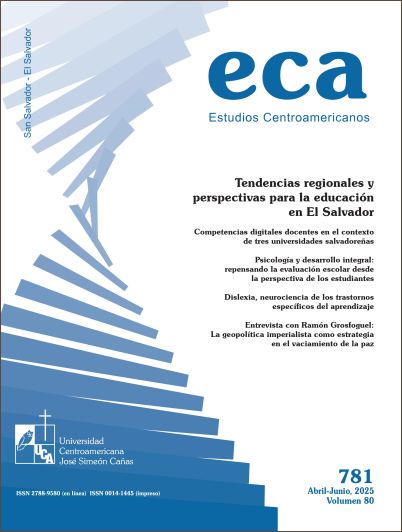
Competencias digitales docentes en el contexto de tres universidades salvadoreñas
Palabras clave:
Competencias tecnológicas, Alfabetización digital, Aula virtualResumen
El avance de las tecnologías digitales ha transformado el panorama educativo, exigiendo a los docentes desarrollar competencias digitales para una enseñanza efectiva en entornos virtuales. En El Salvador, la pandemia de COVID-19 aceleró la transición hacia la educación en línea, destacando la necesidad de fortalecer las habilidades tecnológicas de los docentes universitarios. Al respecto, este estudio tuvo como objetivo analizar las competencias digitales actuales de los docentes de educación superior en tres universidades salvadoreñas. Se adoptó una metodología cualitativa con un diseño transversal y enfoque explicativo. Se revisaron 24 aulas virtuales mediante una guía de observación de 15 ítems, y se realizaron tres entrevistas a profundidad a directores de educación virtual de las universidades estudiadas. El análisis de datos incluyó codificación abierta y axial, complementado con análisis de contenido de documentos institucionales. Los resultados revelan que los docentes universitarios de las tres universidades estudiadas han demostrado avances significativos en la alfabetización digital, principalmente en la creación y actualización de aulas virtuales. Sin embargo, el uso limitado de recursos multimedia, como videos y simulaciones, señala que las competencias digitales aún no se han desarrollado plenamente, especialmente en cuanto a la creación de contenidos interactivos.
118
EPUB 78
Referencias
Ander-Egg, E. (1995). Técnicas de investigación social. Editorial Lumen. https://epiprimero.wordpress.com/wp-content/uploads/2012/01/ander-egg-tecnicas-de-investigacion-social.pdf
Banoy-Suarez, W. y Montoya-Marín, E. A. (2022). Desarrollo de competencias digitales en docentes de educación básica y media. Revista Tecnología Educativa Docentes 2.0, 15(1), 59-74. http://ve.scielo.org/scielo.php?script=sci_arttext&pid=S2665-02662022000300059
Barbazan Capéans, D., Ben Abdellah, K. D. M. y Montes Hoyos, C. M. (2021). La competencia digital docente en educación superior: estado del arte en España y Latinoamérica. Étic@Net, Revista de Educación y Comunicación en la Sociedad del Conocimiento, 21(2), 267-282. https://revistaseug.ugr.es/index.php/eticanet/article/view/20837
Bates, A. W. (2019). Teaching in a Digital Age: Guidelines for Designing Teaching and Learning (2.a ed.). Tony Bates Associates Ltd. https://pressbooks.bccampus.ca/teachinginadigitalagev2/
Echeverría Mayorga, C. A., Escalante de Guardado, K. A. y Onofre Mendoza, N. O. (2023). Alfabetización tecnológica del docente universitario en El Salvador. Revista De Investigación, 2(14), 10-29 https://camjol.info/index.php/revunivo/article/view/17012
European Commission. (s. f). Digital Competence Framework for Citizens (DigComp). European Commission. https://joint-research-centre.ec.europa.eu/projects-and-activities/education-and-training/digital-transformation-education/digital-competence-framework-citizens-digcomp_en
Hernández Sampieri, R. H., Fernández Collado, C. y Baptista Lucio, P. (2014). Metodología de la investigación (6.a ed). McGraw-Hill. https://www.esup.edu.pe/wp-content/uploads/2020/12/2.%20Hernandez,%20Fernandez%20y%20Baptista-metodolog%C3%ADa%20Investigacion%20Cientifica%206ta%20ed.pdf
Koehler, M. J. y Mishra, P. y (2008). Introducing Technological Pedagogical Content Knowledge. En AACTE Committee on Innovation and Technology (Eds.), Handbook of Technological Pedagogical Content Knowledge (TPCK) for Educators (pp. 3-29). Routledge. https://punyamishra.com/wp-content/uploads/2008/05/koehler_mishra_08.pdf
Menjívar Valencia, E. y Pérez Rodríguez, C. L. (2009). Las competencias digitales de los docentes de la Universidad Don Bosco. Roca. Revista científico - Educacional De La Provincia Granma, 19(3), 83-105. https://rd.udb.edu.sv/server/api/core/bitstreams/5e5caaa5-b527-41f3-b693-ab609166f89f/content
Organización de las Naciones Unidas para la Educación, la Ciencia y la Cultura. (2011). UNESCO ICT Competency Framework for Teachers. UNESCO. https://unesdoc.unesco.org/ark:/48223/pf0000213475
Redecker, C. (2017). European Framework for the Digital Competence of Educators: DigCompEdu. Publications Office of the European Union. https://publications.jrc.ec.europa.eu/repository/handle/JRC107466
Rojas Soriano, R. (2013). Guía para realizar investigaciones sociales. Plaza y Valdés Editores. https://raulrojassoriano.com/cuallitlanezi/wp-content/themes/raulrojassoriano/assets/libros/guia-realizar-investigaciones-sociales-rojas-soriano.pdf
Strauss, A. y Corbin, J. M. (1990). Basics of qualitative research: Grounded theory procedures and techniques. Sage Publications, Inc. https://psycnet.apa.org/record/1990-98829-000
Vásquez Peñafiel, M.-S., Núñez, P. y Cuestas Casas, J. (2023). Competencias digitales docentes en el contexto de COVID-19. Un enfoque cuantitativo. PIXEL-BIT. Revista de Medios y Educación, 67, 155-185. https://recyt.fecyt.es/index.php/pixel/article/view/98129
Villota García, S. C., Zamora López, G. G. y Llanga Vargas, E. F. (2019). Uso del internet como base para el aprendizaje. Revista Atlante. Cuadernos de Educación y Desarrollo. https://www.eumed.net/rev/atlante/2019/05/internet-aprendizaje.html
Publicado
Número
Sección
Licencia
Derechos de autor 2025 David Alberto Quintana Pérez, Armando Briñis Zambrano, Pedro Joaquín Torres Serrano

Esta obra está bajo una licencia internacional Creative Commons Atribución-NoComercial-SinDerivadas 4.0.
© ECA. Estudios Centroamericanos está bajo una licencia Creative Commons NonCommercial-NoDerivatives 4.0 International (CC BY-NC-ND 4.0).

La licencia no comercial y sin obra derivada permite la reproducción, distribución y comunicación pública, pero no la posibilidad de comercializar su contenido ni tampoco generar una obra derivada, como una traducción o adaptación, excepto que se pida permiso a los editores de dicha obra.
En ese sentido, se está en la libertad de:
Compartir: copiar y redistribuir el material en cualquier medio o formato.
Bajo las siguientes condiciones:
- Reconocimiento: se debe dar crédito a esta obra de manera adecuada, proporcionando un enlace a la licencia, e indicando si se han realizado cambios.
- Uso no comercial: no se puede hacer uso del material con fines comerciales.
- Sin obra derivada: si se remezcla, transforma o construye sobre ese material, no se puede distribuir el material modificado.